Items on loan to Cardinal Ritter Birthplace help tell story of ‘hometown hero’
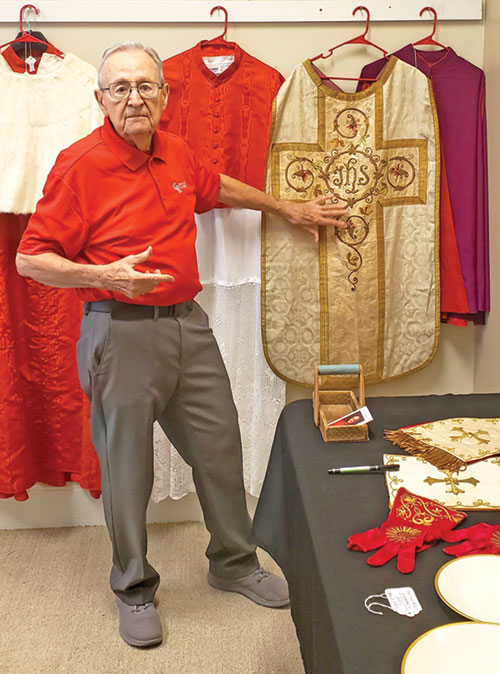
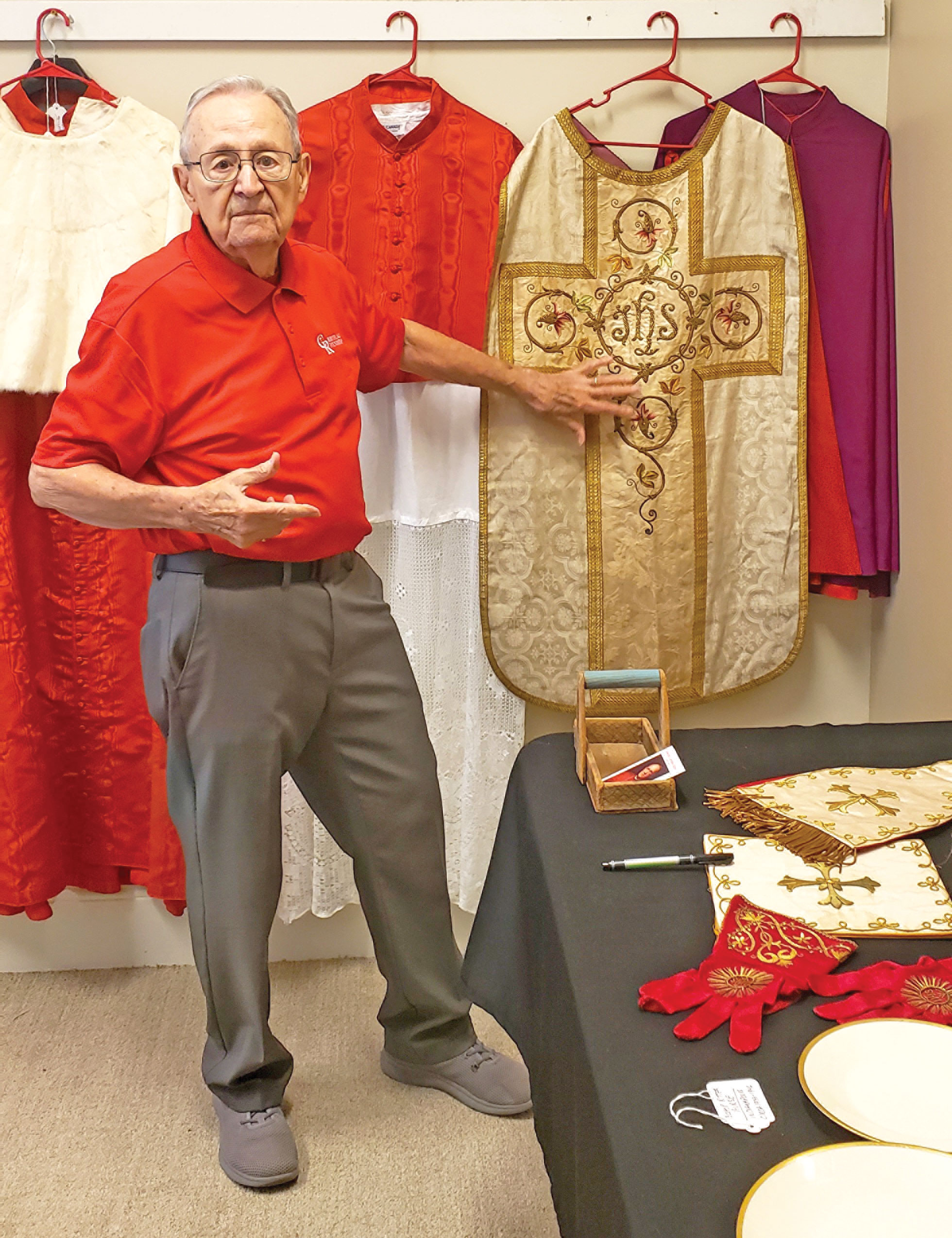
Ray Day, archivist for the Cardinal Ritter Birthplace Foundation, Inc., in New Albany points to a chasuble worn by Cardinal Joseph E. Ritter during his time as bishop (1934-1944) and archbishop (1944-1946) of Indianapolis. The long white vestment (mantelletta) hanging behind Day, the cape (rochet) hanging at far right, and the cream maniple and burse at the top of the table are also Ritter items from the same timeframe. The five pieces are on indefinite loan to the foundation from the Indianapolis Archdiocese’s archives. The white ermine cape (mozzetta), scarlet cassock and scarlet mozzetta behind Day, as well as the liturgical gloves and china on the table, are a few of the Ritter items on indefinite loan from the St. Louis Archdiocese’s archives. (Photo by Natalie Hoefer)
NEW ALBANY—In the New Albany home where Cardinal Joseph E. Ritter was born in 1892, Ray Day points to a 1961 painting of the cardinal wearing a deep red cassock covered by a dazzling white cape—or mozzetta—made of ermine fur.
The ermine mozzetta “is a classic, elegant vestment worn primarily by popes and cardinals,” Day explains.
“And what’s amazing,” he continues as he lifts a hangar from a peg on the wall below the image of the cardinal, “is that right here is the ermine cape he’s wearing in the painting.”
Seeing the same mozzetta that was painted more than 60 years ago is interesting. But what makes it “amazing” is that it was worn by a cardinal born and raised in New Albany who made history for his efforts in desegregation and ecumenism, and for promoting Mass in local languages rather than Latin during the Second Vatican Council.
The garment helps tell the local, national and international story of Cardinal Ritter. It is just one of more than 40 of the cardinal’s vestments, liturgical items and personal possessions on indefinite loan to the Cardinal Ritter Birthplace Foundation, Inc. (CRBFI), by the archives of the two archdioceses he led—Indianapolis and St. Louis.
“We have plans to build a special room to display the items,” says Day. He serves as archivist for CRBFI, which saved the Ritter home from demolition in 2002, restored it and now uses it in part to educate about the cardinal’s life, values and legacy.
He recalls the exact date when the wheels for the donations were set in motion.
‘I was in awe’
On June 28, 2025, a Mass was celebrated to mark the 75th anniversary of the founding of Our Lady of Perpetual Help Parish in New Albany. Three archbishops concelebrated: Indianapolis Archbishop Charles C. Thompson; Seattle Archbishop Paul D. Etienne, a former pastor of the southern Indiana faith community; and Baltimore Archbishop William E. Lori, a son of the parish.
As a member of Our Lady of Perpetual Help, Day was present at the Mass and the dinner that followed.
Sometime prior to that day, he had asked Indianapolis archdiocesan archivist Julie Motyka if the archives had a miter that belonged to Cardinal Ritter. The answer was no, but she did send a photo of him wearing a miter when he was installed as bishop of the Indianapolis Diocese in April 1934.
Day was not deterred by that dead end.
“At the dinner, I went and talked to Archbishop Charles [Thompson] and asked him if there was some way that we could acquire a vestment that [Cardinal Ritter] wore while he was bishop of Indianapolis,” he recalls.
He only asked for one item. “So, I was in awe” when five items arrived on indefinite loan from the archdiocese’s archives in September, says Day.
The items included three of the cardinal’s vestments and two other items he used in celebrating Mass, all from his time as auxiliary bishop (1933-34) and bishop (1934-1944) of the Indianapolis Diocese, and as archbishop (1944-1946) after the diocese was elevated to an archdiocese in 1944.
“The archdiocesan archives was pleased to loan some vestments belonging to Cardinal Ritter for display at the Cardinal Ritter Birthplace Museum,” says Motyka. “One of the best ways for people to learn about the history of our archdiocese is to be able to see items from our past. I hope that those who visit the museum are able to gain a greater understanding of Cardinal Ritter’s many achievements as a leader of the Church both here in Indiana and in St. Louis.”
Day did not stop with Archbishop Thompson on June 28. He asked Archbishop Etienne if he had any connection with Archbishop
Mitchell T. Rozanski of
St. Louis “because we would love to get something of Cardinal Ritter’s from them, too.” The cardinal served as shepherd of the St. Louis Archdiocese from 1946 until his death in 1967.
It turned out the two men did “know each other well,” and that connection paid off. After Archbishop Etienne’s inquiry, Archbishop Rozanski directed Day to contact Eric Fair, director of the St. Louis Archdiocese’s archives and records, and “approved everything that Eric was able to provide,” says Day.
Again, the hope was for one item. And again, more was delivered—much more.
‘They help tell Cardinal Ritter’s story’
“When Eric came here in February and unloaded on us, we could not believe it,” says Day.
The indefinite loan included 36 items worn or used by Cardinal Ritter. Among them were four vestments—including the ermine mozzetta that the St. Louis archives confirmed is the same one in the 1961 oil painting—episcopal gloves and fascia (sash), 13 pieces of formal china with his episcopal coat of arms and more, including the miter identical to the one the cardinal wore in the 1946 photo Motyka sent Day (although the St. Louis archives cannot confirm the two are the same miter).
There was much gratitude that day—and not just from the CRBFI team.
“When Eric walked in the door, he says, ‘This is wonderful! We are so glad that we’re able to do this,’ ” Day recalls.
“I said, ‘Wait a minute, that’s what I’m supposed to be saying to you!’
“But in truth, he was saying what the St. Louis folks were feeling, and I think what Julie and Archbishop Thompson had been feeling—that [the loans] gets these items out of storage and into the public realm where they can help us tell Cardinal Ritter’s story.”
Cardinal Ritter was a champion for Black Catholics. According to the CRBFI website, his “1938 decision to end racial segregation in all Catholic schools in the [Indianapolis] diocese” was completed by 1943, 11 years before the U.S. Supreme Court’s Brown v. Topeka Board of Education decision in 1954 ended racial segregation in public schools. He did the same in the St. Louis Archdiocese.
It was also there that Cardinal Ritter began his ecumenical efforts.
“He started to communicate with the other sects of Christianity, the Baptists, the evangelicals and the Jewish community, even before Vatican II and the documents on ecumenism,” says Day.
In 1961, he became—and remains—the only Indiana native to be elevated to the rank of cardinal.
From 1962-65, Cardinal Ritter participated in the Second Vatican Council, where he was a “major salt-shaker” on efforts to have Mass celebrated in the native language of the people, says Day.
Desegregation, ecumenism and Mass in the vernacular. “Those three things have been [CRBFI’s] goal to educate our community, to appreciate what this individual did from small-town America to big-time Rome,” he adds. “With these items [on loan], we’re really equipped to do that.”
The next step is making it possible “to do that.”
‘Whipped cream and the cherry on top’
Plans are already drawn up for a room to be added on to the home to display the items. Companies have been contracted for construction, electrical and carpentry work, with each of them “donating something—if not all—of their work,” says Day.
But additional funds are needed “for carpeting and other small things to make it a finished piece,” he adds.
Currently, the free museum is open by appointment only—but plans are in motion there, too.
“We hope to set up a calendar of open hours—once a month, twice a month, whatever—and to start slowly but surely building up a set of docents” for tours of the home’s restored front parlor and bedroom, to share about Cardinal Ritter’s life and accomplishments and to discuss the items on loan.
The Cardinal Ritter Birthplace Museum and its collection are unique, notes Day.
“To my knowledge, we’ll be the only place except a building in Indianapolis and a building in St. Louis where you can see so many Cardinal Ritter artifacts,” he says.
The cardinal’s impact on the Church and society make him a “hometown hero,” Day adds.
“It’s important that we know where [those accomplishments] came from,” he says. “And they came from right here at 1218 Oak Street in New Albany.
“We’re the only place people can go and get a little bit of Indianapolis and a little bit of St. Louis and a whole lot of Ritter for a complete meal.
“With these [loaned] items, we’ve just been given the whipped cream and the cherry on top.”
(To learn more about Cardinal Ritter Birthplace Foundation, Inc., the museum, other aspects of its mission, or to donate, go to cardinalritterhouse.org. Scroll down the site’s homepage for downloadable documents with photos and information on the Cardinal Ritter items on indefinite loan from the archives of the archdioceses of Indianapolis and St. Louis. For information on becoming a docent, send an email to rbmdcarter@gmail.com or leave a message at 502-216-9197.) †
Related story: From humble background, a child grows up to shape the country, Church