From humble background, a child grows up to shape the country, Church
By John Shaughnessy
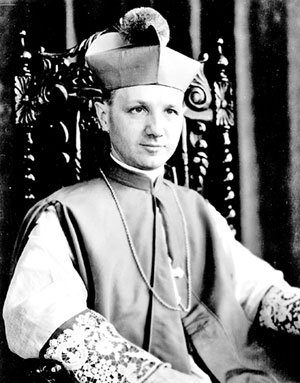 He was born in a small, second-floor room above his family’s bakery in New Albany.
Some of his family members brewed beer in the basement of the house during the years of Prohibition in the United States.
From this humble and colorful background, the child grew up to help shape the archdiocese, the United States and the universal Church.
Cardinal Joseph E. Ritter especially became known for being color-blind when it came to one of the most divisive aspects of education in American history—the desegregation of schools.
In 1937, then-Indianapolis Bishop Ritter began his plan to integrate the Catholic schools in the archdiocese—17 years before Brown v. Board of Education, the landmark 1954 U.S. Supreme Court decision which held that racial segregation of children in public schools was unconstitutional.
In 1937, Bishop Ritter contacted Father Bernard Strange of St. Rita Parish in Indianapolis—then a predominantly Black parish—and shared his desire to have children from the parish attend a Catholic high school, according to information in the archives of the archdiocese.
On the first day of school in 1937, five Black girls arrived at then-St. John Academy in Indianapolis and were welcomed by the Sisters of Providence who taught there—a welcome that wasn’t universally shared.
Some parents objected to the move. So did some alumnae, and at least one pastor. Amid this emotionally-charged atmosphere, Bishop Ritter continued his integration efforts in Catholic schools—efforts that led the Klu Klux Klan to protest outside SS. Peter and Paul Cathedral in Indianapolis.
Nor was he deterred later by protests as he continued that mandate in St. Louis after he was installed as archbishop there in 1946.
His influence also extended to the universal Church. Named a cardinal in 1961, he was heavily involved in the Second Vatican Council, being a chief promoter of its “Declaration on Religious Freedom,” a landmark document that has shaped the Church’s promotion of religious liberty ever since.
After his 2019 tour of the Cardinal Ritter House in New Albany—the childhood home of the cardinal—Archbishop Charles C. Thompson reflected on the legacy of this man who was ordained a priest in what was then the Diocese of Indianapolis in 1917.
“We’re all called to holiness. We’re all called to become saints,” Archbishop Thompson said. “This man born in a room upstairs over a bakery, above where beer was being made, can go on to do the great things he did in Indianapolis and St. Louis and the Second Vatican Council. It reminds all of us that that potential is in all of us.
“God doesn’t call us to anything that God doesn’t give us the grace to do. So, what stands out is that this ordinary person, like us, went on to do great things. And he did it not because he was in a privileged position, but he was a man of faith who allowed the Spirit to guide him, who took seriously his baptismal call to serve, to love, to proclaim the Good News, to live the faith. And that’s an example for all of us.” †
Related: Indiana’s Catholics reflect American spirit of courage and sacrifice