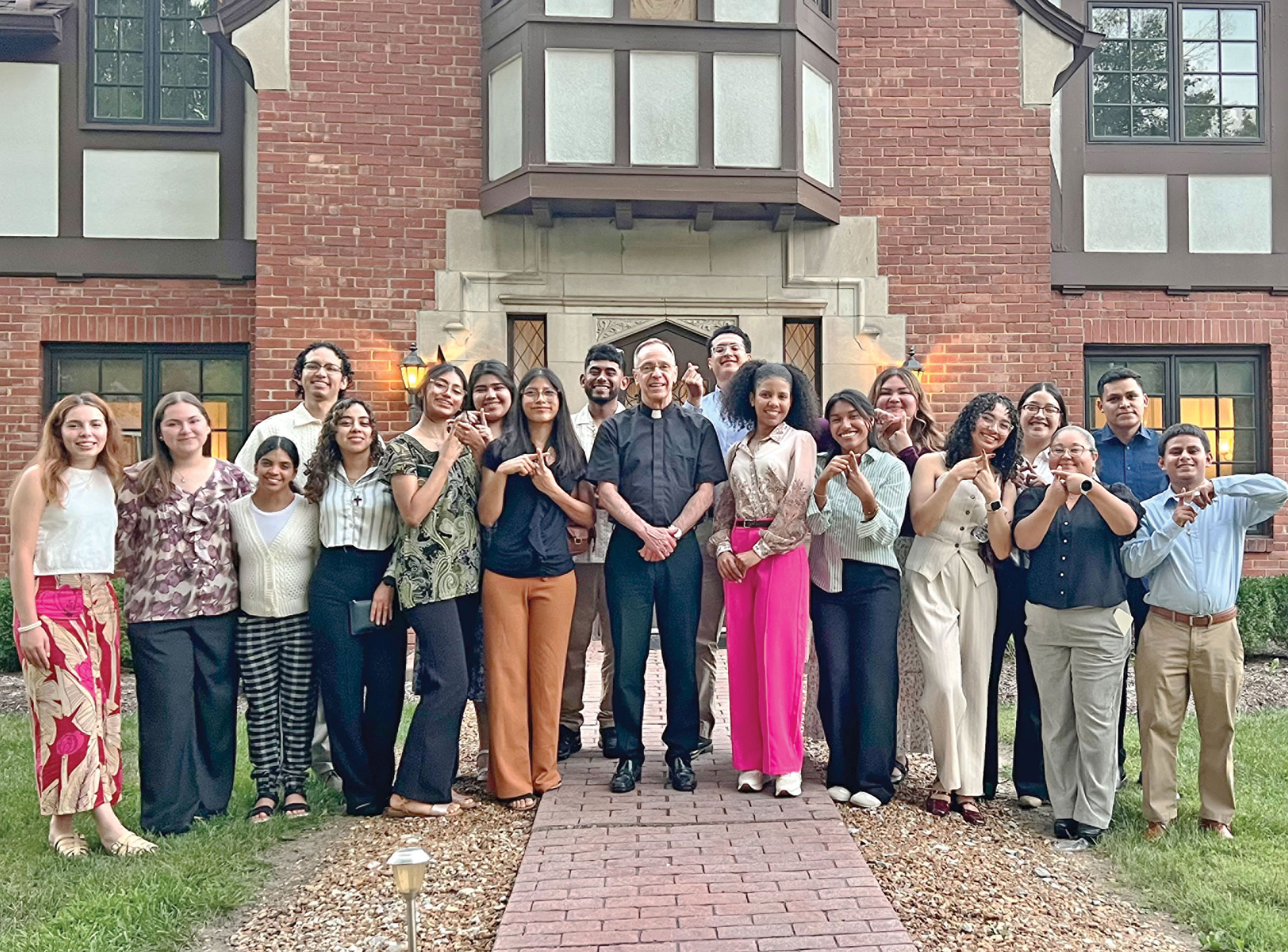
Hispanic young adults gather with Archbishop Thompson
(En Espanol)
Hispanic young adults pose with Archbishop Charles C. Thompson in front of his home in Indianapolis after a dinner on Sept. 1 coordinated by the archdiocesan Pastoral Juvenil Hispana ministry. (Submitted photo)
By Jose Quintana (Special to The Criterion)
On Sept. 1, the residence of Archbishop Charles C. Thompson became a place of conversation, fellowship and hope as Hispanic young adult leaders from across the archdiocese gathered for dinner with their shepherd.
The dinner was hosted through the Pastoral Juvenil Hispana, a ministry of the archdiocesan Office of Hispanic Ministry dedicated to accompanying Hispanic young adults through faith formation, leadership development, community-building and service. The ministry is composed of a board of young adult leaders who help organize events and create opportunities of encounter for the broader Hispanic young adult community.
The evening was more than simply a meal. It was an opportunity for young adults from different parishes and communities to sit at the same table, share their experiences and speak openly about the future of the local Catholic Church.
Two questions emerged as central to the conversation: What can the Church offer the community? And what can young adults offer the Church?
Those questions took on particular significance, given the circumstances surrounding the gathering.
Just days before and after the dinner, Indiana experienced a significant increase in immigration enforcement activity. According to a Sept. 16 press release from U.S. Immigration and Customs Enforcement (ICE), 426 people were arrested across Indiana between Aug. 30 and Sept. 3 as part of Operation Safe Community-Indiana, a five-day enforcement operation conducted with state and local law enforcement agencies. Much of the operation was concentrated in the Indianapolis metropolitan area.
For many Hispanic families, the increased enforcement brought fear and uncertainty into their everyday lives. The dinner therefore offered something especially meaningful: a space where young Hispanic Catholics could gather with one another and with the archbishop not simply as parishioners, but as leaders, sons and daughters, students, professionals and members of the wider Church community.
The gathering also came shortly before Archbishop Thompson issued on Sept. 4 a temporary dispensation from the obligation to attend Mass on Sundays and holy days of obligation for Catholics who had reasonable grounds to fear immigration detention, separation from their families or intimidation because of increased immigration enforcement. The dispensation remained in effect through Sept. 30.
In a statement accompanying the decree, Archbishop Thompson acknowledged the difficult circumstances facing immigrant communities.
“While recognizing the need for law enforcement to protect and defend, it is gravely concerning to witness families being torn apart,” the archbishop wrote. “The family, the fabric of stability in our society, must be cherished and defended.”
He also emphasized the inherent dignity of every person and called for people to be treated with dignity, compassion and respect.
Against that backdrop, the dinner on Sept. 1 offered a meaningful space for connection, which was particularly important as the Church in the United States becomes increasingly Hispanic.
In an article published in the June 3, 2024, issue of America magazine, professor Hosffman Ospino of Boston College noted that nearly 45% of U.S. Catholics—and more than half of Catholics younger than 30—identify as Hispanic. He described second- and third-generation young Hispanics as the fastest-growing sector of the Catholic community. Ospino argues that the Church must increasingly accompany, form and empower young Hispanic Catholics to become leaders within the Church and society.
The implications are significant for dioceses like Indianapolis.
Ospino writes that Hispanic Catholic leaders have the opportunity to bring their gifts and energy to “build, transform and even redefine existing Catholic ministerial structures,” drawing from their own cultural and spiritual traditions.
That vision was represented around the dinner table at Archbishop Thompson’s residence.
For Liz Ponce, a student at Indiana University Indianapolis and a member of St. Mary Parish in Indianapolis, the gathering was an opportunity to experience that sense of community firsthand.
“This was my first time attending a dinner like this, and it was such a wonderful experience,” Ponce said. “It felt so nice to have genuine conversations with everyone and meet people from different [parishes] who all came together to connect.”
For Ponce, one of the most meaningful parts of the evening was hearing the stories of other young Catholics.
“I really enjoyed hearing everyone’s stories and getting to know people outside of my own church community,” she said. “I think creating spaces like this is one of the best ways to bring people together, build relationships and strengthen our faith community.”
The dinner also reflected a broader question facing the Church: How does it accompany a young generation that increasingly represents its future?
In his column, Ospino argues that Hispanic ministry must increasingly move beyond a model focused primarily on ritual and social assistance toward one that also empowers Hispanic Catholics to form strong families, become engaged citizens and assume leadership in the Church and society.
The September dinner was a small but meaningful expression of what the Church can offer its Hispanic young adults: a place to gather, be heard and belong. Amid a difficult moment for many Hispanic families across Indiana, the evening offered a hopeful reminder that the Church’s response begins with accompaniment, which involves creating spaces for conversation, strengthening community and inviting young people not only to participate in the Church, but to help shape its future.
(Jose Quintana is an intern for the archdiocesan Office of Hispanic Ministry. For more information on Pastoral Juvenil Hispana, contact archdiocesan Hispanic Ministry coordinator Alden Budier Hebbert at abudier@archindy.org or 317-236-7312.) †