2027 United Catholic Appeal
‘You’re worthy of love’: program guides children, parents to avoid dangers of social media
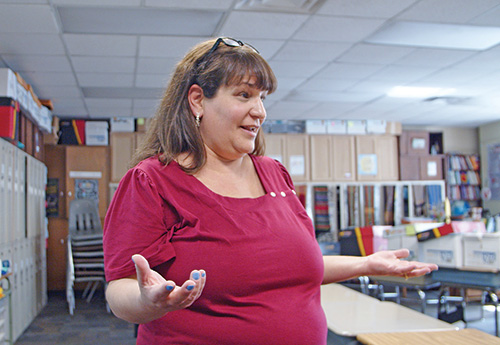
Theresa Chamblee leads the archdiocese’s “Protecting Our Children” program, a program that’s made possible by the United Catholic Appeal and that empowers students to avoid the dangers of social media. (Photo courtesy of Cantaloupe)
By John Shaughnessy
Theresa Chamblee still gets emotional when she thinks about a special moment of love and support, a moment that convinces her that all she is doing to educate and protect children from online predators and even their own doubts and worries greatly matters.
The moment occurred about a month after Chamblee presented the “Protecting Our Children” program to eighth-grade students at a Catholic school in the archdiocese.
“The principal reached out to me to let me know that the program is making an impact because they had a seventh-grade student, a girl, who had met someone online,” recalls Chamblee, the director of Social Concerns for Catholic Charities in the archdiocese. “She was starting to get scared about it, and she didn’t know how to shut it down.
“It was the eighth-grade girls who just kind of surrounded her with love and told her to shut it down. They were really supportive of the seventh grader, who then felt like she could talk to someone about it.
“A big part of the program is empowering our kids to be able to have the back of their friends. Youths standing with youths and saying, ‘You’re not alone.’ I just love that. It gives me chills.”
The “Protecting Our Children” program is just one of the many efforts of the Social Concerns ministries in the archdiocese, ministries that also include connections with parishes to help the poor and vulnerable, anti-trafficking education, promotion of justice for immigrants and programs for domestic and international humanitarian assistance.
The “Protecting Our Children” program and these other Social Concerns ministries wouldn’t be possible without financial contributions to the archdiocese’s United Catholic Appeal, Chamblee says.
“It is very critical. I work directly with parishes and Catholic schools in the greater community. There’s no grant money out there for this type of ministry,” she says. “I’m really humbled by all the individuals who share their time, talent and treasure because we can’t do this alone. We are all Church. We are all one family.”
‘The answer is love’
Like all the Social Concerns ministries, the “Protecting Our Children” program approaches its efforts from the twin foundations of love and faith.
“The program came about because I had so many parents and so many teachers telling me their stories,” Chamblee says. “We’re seeing such a rise in depression and anxiety associated with social media and gaming apps. But what was most scary was when I found out that the number one way our kids are being targeted for sexual exploitation and trafficking is through social media and gaming apps.
“Whether I give a parent presentation or a student presentation, I always ask, ‘What is one thing we all need to survive besides air, water and food?’ The answer is love. We were created in love, to be loved, and we are loved by a God of love.
“And so, I thought it was very important that the very first session [of three] really hone in on that. We don’t even go into social media and trafficking. The first session is all about telling these kiddos, ‘You’re worthy of love. You’re unrepeatable. God wanted you to be.’ ”
One of the most revealing results of the program—which is geared toward seventh- and eighth-grade students—has come through inviting students to privately share their thoughts and concerns on the index cards that Chamblee gives them during her presentations. The students are also invited to write their names or initials on the cards if they want to talk to someone one-on-one.
Chamblee notes, “There have always been at least two to three index cards that I receive back of just someone saying, ‘I’ve never talked about this, but I need help.’ ‘How do I not hate myself?’ ‘How do I not struggle with what other people think of me?’
“One of the parts of the program that is so important is to help them understand they’re not alone. They’re not alone in the mistakes they’ve made. That they are worthy of being loved no matter what. Every single class, we have someone who will write something on those cards that breaks my heart. At the same time, I’m like, ‘Wow, that kid is brave,’ to be able to say, ‘I don’t want to do this anymore. I don’t want to walk alone anymore.’ ”
‘They knew they had a safe place’
In four years of sharing the program, Chamblee has visited more than 40 schools in the archdiocese, reaching an estimated 2,000 students and 2,000 parents. She praises the archdiocese’s Office of Catholic Schools for its support of the program. Staff members at St. Mark the Evangelist School in Indianapolis are among the school leaders who believe all schools should embrace the program.
“We’ve had ‘Protecting Our Children’ in our school for around three years now, and we’ll continue to keep it coming back every year,” says Jen Kocher, St. Mark’s principal.
“There are a handful of companies you can use to come in and help educate your students on being safe online, but the piece that they’re missing that we get from ‘Protecting Our Children’ is the piece where they teach them to love themselves, and they teach them their self-value.”
Rachel Gehret has seen the difference the program has made in her role as St. Mark’s middle school religion teacher.
“This program aligns so well with the foundational things of what I teach as a Catholic school teacher, where we are created in God’s image and likeness, and we are made for love and by love,” Gehret says.
“There have been times where I’ve noticed that students have struggled, and after this program, it’s really helped empower them to stand up and speak for themselves when they need help. And it’s helped them empower each other.
“Sometimes, the girls are struggling with self-esteem issues. They don’t know who they can go to, to say that they don’t feel good about themselves, that they don’t know how to love themselves. And having this, where we see concerning things on the index cards, we can connect the girls or boys with our guidance counselor—and just give them the tools to recognize the gift that they are.”
The program is also designed to help parents who often ask Chamblee, “How do I start to talk to my kids about this?”
“I’m going to give them resources of how to start those conversations because it’s not easy for anyone,” says Chamblee, a mother of six. “The number one thing that kids have said that has helped them from falling prey to these grooming methods online is that they knew they had a safe place to fall. They knew they had a safe place where they could go and say, ‘I made a mistake’ or ‘I just got this crazy, explicit picture. I don’t know what to do.’ And it takes that fear away for them.
“So, having a safe place to land with a trusted adult, their parents, their grandparents, that’s probably the greatest preventer of them ever being groomed online.
“Our kids have to navigate through things that we couldn’t even fathom ten years ago. And for them to just know that they can talk to someone about that is huge.”
The program is a necessity in a time of ever-increasing social media concerns and challenges concerning children’s safety and well-being, says Kocher, St. Mark’s principal.
“The ability to be able to bring this program in at little to no cost to our school is a value I can’t put a number on,” she says. “So those who are donating or supporting the United Catholic Appeal, you’re helping make this possible in our schools.”
(For more information about Social Concerns ministries in the archdiocese, go to www.archindy.org/socialconcerns.) †
Related: See stories from our special section highlighting ministries supported by United Catholic Appeal