2026 Vocations Awareness Supplement
Seminarians credit experience in Catholic schools in their discernment
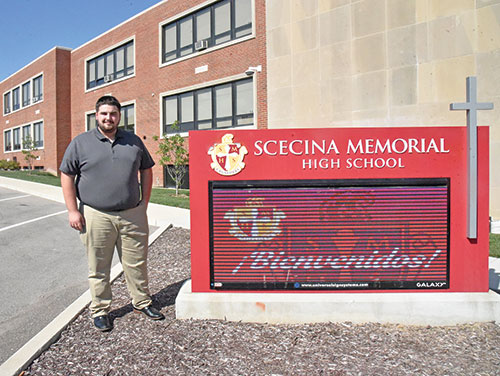
Seminarian Dean Cheever stands outside of Father Thomas Scecina Memorial High School in Indianapolis on Oct. 13. A Scecina graduate, Cheever is in his second year of priestly formation at Bishop Simon Bruté College Seminary and Marian University, both in Indianapolis. (Photo by Sean Gallagher)
By Sean Gallagher
God can lead a person to his or her vocation through many channels of grace: parents, friends, a pastor, a spiritual director, prayer and the sacraments.
In addition to these influences, several current archdiocesan seminarians also identify the experiences they had in Catholic schools in the archdiocese as a means by which God led them to consider a possible call to the priesthood in their lives.
Within those school communities were many pathways of God’s grace for the seminarians: fellow students, chaplains, teachers and an overall culture in the school in which discerning a vocation to religious life or ordained ministry is affirmed and encouraged.
Four of these seminarians spoke recently with The Criterion about how their experiences in Catholic schools helped them get to where they are today.
Influential priests
The presence of priests in schools, either serving as chaplains in high schools or simply as a pastor regularly present in his parish’s school, has laid the groundwork for the discernment of three seminarians.
Seminarians Josh Russell and Nathan Huynh are both in their fourth year of priestly formation at Bishop Simon Bruté College Seminary and Marian University, both in Indianapolis.
They were previously students at Providence High School in Clarksville and gave credit to priests who served as chaplains at the school as helping them to grow in their faith and opening their hearts to a possible priestly vocation.
Father Adam Ahern was a chaplain at Providence in Russell’s freshman year there. Making the sacrament of penance available daily during students’ lunch periods in the cafeteria made confession an ordinary part of the life of faith for Russell.
“It ended up becoming a part of conversation, ‘Hey, I’m going to go to confession. I’ll be right back,’ ” Russell said. “It was very normal. I always appreciated that.
Even among my
non-Catholic friends, it was fine to talk about because he made it normal.”
Father Daniel Atkins, a retired archdiocesan priest who died on Sept. 25, was a source of encouragement for both Russell and Huynh.
“He was very understanding, very patient with me when I was really struggling with a lot of things,” recalled Russell, a member of Holy family Parish in New Albany. “He chose to spend time seeing me just as a son of God and that was it. That was his whole job. That was his whole life. And he really lived that out in a way that was helpful for me.”
After Huynh told Father Atkins that he had an interest in the priesthood, the priest gave him “advice and spiritual readings on the discernment process and what it’s like being in the seminary,” recalled Huynh, a member of Our Lady of Perpetual Help Parish in New Albany.
“I would also see him every Thursday when I would go to daily Mass, so I was able to grow closer to him that way, too,” Huynh added. “Seeing how joyful he was doing his ministry work inspired me because it truly showed that he was doing it for the love of Jesus.”
Russell spent two years as a volunteer for a Catholic ministry after graduating from Providence before he became a seminarian. He looks back on the priests who served as chaplains at his high school as being critical to his future discernment.
“If not for those two men, I wouldn’t be in seminary right now,” Russell said. “I’ve got immense gratitude for Providence as an institution for providing a space to have such great [priests] and grateful for their example.”
Father Robert Gilday, now retired, was the only pastor that seminarian Dean Cheever knew through his high school years as a member of St. Therese of the Infant Jesus (Little Flower) Parish in Indianapolis.
“He was a constant presence in the school,” said Cheever, who is in his second year of formation at Bishop Bruté and Marian. “He was a great pastor and strong in the faith. He was a very good inspiration to me.”
Influential teachers
Cheever also noted that two of his theology teachers at Father Thomas Scecina Memorial High School in Indianapolis helped him become open to the priesthood.
Both were young adults and had previously been seminarians for dioceses outside of Indiana.
“It was very humanizing just to be able to see younger men that I think I could relate to more who had a positive experience in seminary but didn’t ultimately become priests,” Cheever recalled of the teachers, who are no longer on Scecina’s faculty. “They were very passionate about the faith. That was a very good example to me.”
Seminarian Lucas LaRosa recalls the encouragement to consider the priesthood he received at Roncalli High School in Indianapolis more than a decade ago from now-retired Deacon Thomas Horn, who was a religion teacher for him there.
“I still look back on that 13 years later,” said LaRosa, who is a seminarian at Saint Meinrad Seminary and School of Theology at St. Meinrad. “It did have an impact on me. It was an honor.”
Another religion teacher for LaRosa in his time at Roncalli was Patrick Verhiley, now director of the Catholic Franciscan Leadership Program at Marian University.
LaRosa described him as “an awesome teacher” who had “a really clear and strong devotion to the Lord.”
The conviction of faith that LaRosa saw in Verhiley led him to take his spiritual advice seriously.
“It was like, if Mr. Verhiley says so, then I’ll do it,” LaRosa recalled.
Russell spoke about how Diana Welch, a biology teacher at Providence, helped deepen his faith.
“She wanted us to know biology, yes,” Russell said. “But she also wanted us to know facts about the empirical world that would really draw us to understand and better appreciate Jesus Christ and the miracles that we attest to in the Church.”
The connection between biology and the faith was especially highlighted for Russell in Welch’s class when they studied a book during Lent that examined Christ’s experience in his passion and death from scientific and medical perspectives.
He described it as “a scientific process” that helped him “connect who I believed God to be” with “what I believe God went through.”
Influential students and school experiences
Cheever pointed to the friendship at Scecina that he shared with his brother Joe and with Ian McKiernan, both now in their first year of formation at Bishop Bruté and Marian.
“The three of us would talk about our experiences and the way that we’ve grown deeper in the faith,” Cheever said. “That was just a very good group to have.”
Huynh said the opportunity he had as a senior at Providence to help lead a retreat for juniors was influential for him.
“Being able to share my faith was good ‘practice’ for being a priest, since by my junior year I was dead set on joining the priesthood,” he said.
Years after he took part in it, LaRosa still looks back on his senior retreat at Roncalli as playing a pivotal moment in his life of faith.
“It was a really moving experience where I felt a lot of love both within my own relationship with God, with my family, with my friends, my classmates whom I may or may not have known that well,” LaRosa said. “When I went forward into college and into the workforce, the things I learned from that senior retreat were what I wanted to hold onto.
“It was having your own relationship with God but also seeing that through your friends and family’s eyes, too, and feeling that love of the Father through them as well.”
In addition to his senior retreat, LaRosa also had the opportunity of a lifetime during his senior year when he was one of four Roncalli students selected to go to the Vatican for the canonization of St. John XXIII, whose name before his election as pope was Cardinal Angelo Roncalli.
Because he was declared a saint in the same liturgy in 2014 as St. John Paul II, the crowds in Rome were enormous. LaRosa, his fellow students and then-Roncalli principal Chuck Weisenbach waited in line all night to get a place in St. Peter’s Square for the canonization Mass.
“Everyone was packed in like sardines, pushing forward, trying to get as close to the front as possible,” LaRosa recalled. “We knew we were in it for the long haul. This was a global thing. I got to live one of the biggest moments in the school’s history.
“Looking back, that definitely had a cool impact on me in my life.”
By the numbers, promoting a culture of vocations
The high schools of the seminarians featured above are not the only ones in central and southern Indiana that have graduates who are current archdiocesan seminarians.
At present, the archdiocese has seminarians from six high schools operated by the archdiocese or its parishes and from three independent Catholic high schools.
Roncalli currently has 22 graduates who are priests, three women in religious life and three more women who are currently novices.
Seven Providence graduates are either currently priests or who died as priests, including Father Atkins. Six women who graduated from Providence are currently religious sisters. Additionally, Benedictine Abbot Brendan Seipel of St. Bernard Abbey in Cullman, Ala., is also a Providence graduate.
Likewise, seven Scecina graduates went on to be ordained priests, with one now deceased. And seven graduates of the school went on to become women religious, with one now deceased.
As a member of the Roncalli graduation class of 1979, a teacher from 1984-90 and after serving as an assistant principal, principal and in his last year as school president, Weisenbach has a good perspective on how Roncalli has nurtured a culture of vocations over the years in which students are encouraged to embrace whatever vocation to which God is calling them.
“The overall message that we’re constantly trying to share with our students is, ‘What is God calling us to be?’ ” Weisenbach said. “He’s given each of us a set of gifts and talents that’s unique. What’s he asking us to do with these gifts and talents? Let’s be open to that.”
If students express an openness to vocations to religious life or ordained ministry, Weisenbach said the whole school community will “hold them in high esteem, which I think has been encouraging.”
(For more information about a vocation to the priesthood in the Archdiocese of Indianapolis, visit HearGodsCall.com.) †