Archbishop, priests reflect on the powerful witness of Archbishop Sheen
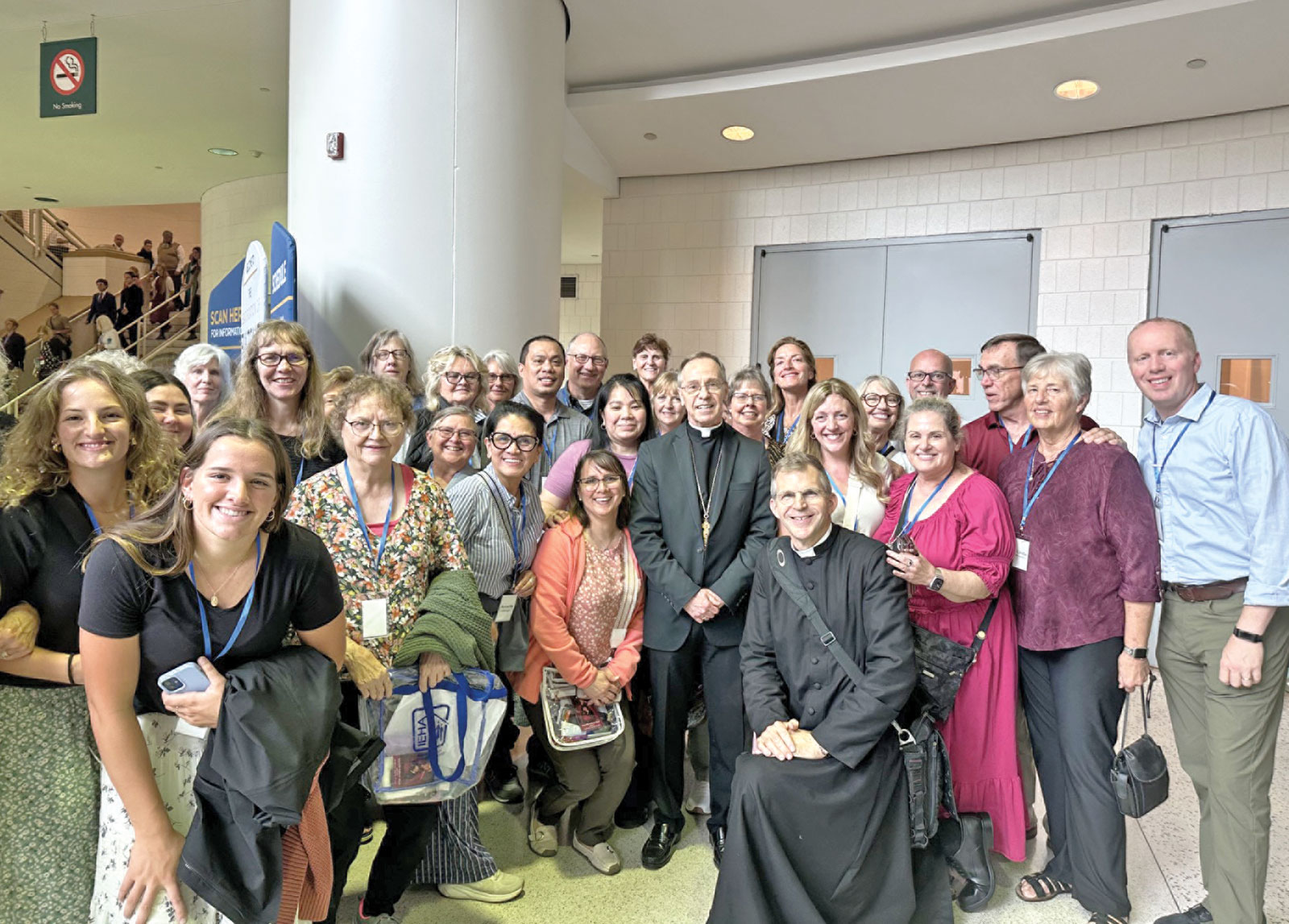
Archbishop Charles C. Thompson (center) poses on Sept. 24 with Father Jonathan Meyer and members of the four parishes Father Meyer serves in Dearborn County before the beatification Mass for Archbishop Fulton J. Sheen at The Dome at America’s Center in St. Louis. (Submitted photo)
By Sean Gallagher
Priests young and old who serve the Church in central and southern Indiana all point to Blessed Fulton J. Sheen as a role model and inspiration, not only for themselves, but for all the faithful.
Some of these priests, as well as Archbishop Charles C. Thompson, spoke with The Criterion about the role played in their lives by the archbishop who died in 1979 and was declared blessed during a Sept. 24 beatification Mass at The Dome at America’s Center in St. Louis, the last step before his canonization.
‘A brilliant microcosm of the Church in the United States’
Archbishop Charles C. Thompson was a concelebrant at the beatification Mass, wearing a pectoral cross that had been given to Blessed Fulton in 1951 by Pope Pius XII on the occasion of his ordination as a bishop.
It came into the possession of the archdiocese through Archbishop Edward T. O’Meara, a longtime friend of Blessed Fulton and the executor of his will. Archbishop O’Meara led the Church in central and southern Indiana from 1979-91. The pectoral cross that Archbishop Thompson wore at the liturgy is now preserved in the archdiocese’s archives.
“It was very humbling and an honor,” Archbishop Thompson said of the beatification Mass. “It was inspiring. I thought about Archbishop O’Meara’s connection with Fulton Sheen.”
Archbishop Thompson praised Blessed Fulton’s ability to “touch hearts and inspire people, and not just Catholics,” noting that “he used those gifts to the fullest to make a difference in the lives of others with the Gospel.”
The archbishop spoke about how he was impressed by “the energy and enthusiasm” on display at the Mass and called the 50,000 people who took part in it “people proud of their faith, people loving their faith, people celebrating their faith.”
“You had everybody there: bishops, priests, deacons, cardinals, religious men and women, families,” he said. “It was a brilliant microcosm of the Church in the United States. It was a great day to celebrate as a Church in the United States and beyond.”
‘One soul makes this much difference’
Father Jonathan Meyer was only 3 when Blessed Fulton died. He did not grow up watching him on weekly TV like so many of his parents’ and grandparents’ generations did.
The priest first began to learn about him, and learn from him, when he became an archdiocesan seminarian in the late 1990s.
It was then that Father Meyer sought to adopt Blessed Fulton’s decades-long practice of praying before the Blessed Sacrament for an hour every day, a devotion traditionally called a Holy Hour.
He described in simple terms his motivation for following in Archbishop Sheen’s footsteps in this practice: “I wanted to be a saint. There was no other desire in my heart.”
Archbishop Sheen’s fidelity to a daily Holy Hour contributed to the holiness for which he is now recognized by the Church.
It was his holiness that drew thousands on Sept. 24 to St. Louis for Archbishop Sheen’s beatification. Father Meyer went to the liturgy with 48 members of the four parishes he serves in Dearborn County.
“As I processed into The Dome, I just began crying,” said Father Meyer. “To see so many people who were there gave me so much hope.
“One man had this much of an impact, and in reality so much more. One priest did this. One child of God did this. One soul makes this much of a difference. It was powerful.”
Memories to last a lifetime
Retired Msgr. Joseph Schaedel has memories of watching Archbishop Sheen on TV when he was a child in the 1950s.
“To be honest, I don’t remember much of what he said,” Msgr. Schaedel said. “But, as a youngster, I was fascinated with his flowing cape and the invisible ‘angel’ who would erase his chalkboard when he moved to the other side of the room.”
Being ordained a priest in 1982 by Archbishop Edward T. O’Meara, a close friend of Blessed Fulton, “intensified” Msgr. Schaedel’s “appreciation and knowledge” of Archbishop Sheen.
Like Father Meyer, Msgr. Schaedel has sought to make a Holy Hour a daily part of his priestly life and ministry.
He was a concelebrant at the beatification Mass, describing it as “one of the most memorable—if not the most memorable” liturgies of his life.
The beatification liturgy helped Msgr. Schaedel realize that Blessed Fulton was declared blessed not because of his great ministry as an evangelist or as a promoter of missionary work around the world.
“Sheen was beatified because he was holy: a man of prayer and unwavering devotion to the Blessed Sacrament, our Lady, the priesthood and the Church,” Msgr. Schaedel said. “The beauty and reverence during the liturgy brought this home for me. It renewed in me [the desire] to strive to be holy no matter what ministry I may be involved in. Devotion to Jeus Christ is all that counts.”
Retired Father James Bonke said Blessed Fulton’s TV show was “must-see TV” when he grew up in the 1950s. But it was his experience as a young priest in the 1970s of hearing him speak during a preaching workshop that forever cemented the prelate’s effect on his priestly life and ministry.
Blessed Fulton spoke to the priests at the workshop in the Basilica of the National Shrine of the Immaculate Conception in Washington, D.C.
“I remember him ascending the pulpit in the basilica and speaking in his deep stentorian voice, dressed in bishop robes and with his piercing eyes,” recalled Father Bonke. “He was impressive.
“But at some point in his presentation, he stretched out his arms and pointed to the back of the church and beyond. He said, ‘If you can’t find God out there, you won’t find him in here.’ It was a powerful message and has remained with me all these years.”
Archbishop Sheen made an impact on the life of retired Father Carlton Beever at a younger age and at a crucial time in his life. He was a fourth-grade student in 1956 at the former St. Bernadette School in Indianapolis when he and his family were preparing to be received into the full communion of the Church.
Both the instruction in the faith that he and his family received and watching Archbishop Sheen on TV “began the foundation of our faith,” Father Beever said, adding that “his way with words” and his “commanding presence” were a spur to his practice of the faith as a child.
“Every week, no matter what, my whole family stopped whatever we were doing and gathered in front of the TV to watch him,” he recalled. “It wasn’t an expectation or a command performance. We looked forward to his show. I think we were just drawn to him.”
Retired Msgr. Mark Svarczkopf didn’t just watch Archbishop Sheen on TV. The weekly shows were part of the lesson plan of the members of the Sisters of Providence of Saint Mary-of-the-Woods, who taught him at the former St. Andrew the Apostle School in Indianapolis.
“They would assign us to watch ‘Life Is Worth Living,’ ”
Msgr. Svarczkopf recalled. “Then you had to turn in a report—and the report had to have some depth into it. They wanted to know what the real teaching of the Church was that he shared.”
The retired priest reflected on the impression that Archbishop Sheen made on young men of his generation as they discerned God’s call in their life.
“There was a holiness in him that we were all seeking,” Msgr. Svarczkopf said. “It was not just Hollywood. There was a real holiness about him and a desire to learn about God.”
A Mass that made a ‘lasting impression’
Dominican Father Patrick Hyde, pastor of St. Paul Catholic Center in Bloomington, was born in 1985, six years after Archbishop Sheen died. He only began to delve deeply into his writings when he joined the Dominicans.
Father Patrick described the role that Blessed Fulton’s 1963 book on the priesthood, The Priest Is Not His Own, had on his vocational discernment.
“I found his approach to the priest as being a [sacrificial] victim at as well as a priest enlightening,” he said. “It really helped me deepen my understanding of my own vocation. Though a lot of work and prayer preceded my reading of that book, I attribute my decision ultimately to pursue the Dominican priesthood to that book.”
So, it was a blessing for Father Patrick to take part in the beatification Mass of a man who played such an important role in his priestly life and ministry.
“One of the beautiful parts of our Catholic faith is the intercession and veneration of the saints,” he said. “To be able to participate in a liturgy where someone is declared blessed … was an incredible blessing.”
At St. Paul, Father Patrick ministers to a growing number of Indiana University students who are embracing the Catholic faith. He accompanied a large number of them to the beatification Mass.
“To attend Mass with 50,000 people … was a tremendous gift for the students who were able to attend,” he said. “In fact, one of the members of our group is in OCIA [the Order of Christian Initiation of Adults], and this was only the fifth or sixth Mass he ever attended. Needless to say, it made quite a lasting impression.”
The liturgy made an impression on Father Patrick, too, as he was “deeply moved” when a jawbone of Blessed Fulton held in a reliquary was brought in a procession to the sanctuary at the Mass after he was declared blessed.
“As I have thought about that, it has made me realize how tangible the saints now are to me as an American priest,” Father Patrick said. “To be a saint is to not be someone from a different era and culture, but to do the will of God in the circumstances I face in an increasingly complex and technologically advanced world.” †
Related story: Readers share how Blessed Fulton Sheen touched their lives, deepened their faith
Related story: Blessed Fulton J. Sheen helped shape the pastoral leadership of Archbishop O’Meara