Benedictine Father Boniface Hardin worked for racial justice in Indianapolis
By Sean Gallagher
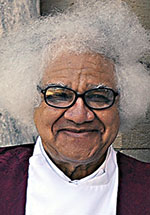 The great-grandson of an enslaved person, Benedictine Father Boniface Hardin grew up in the 1930s experiencing everyday the ongoing effects of slavery. That experience, and knowing his family’s roots in the bondage of slavery later led him to be a noted advocate for racial justice in Indianapolis.
He shared his story with author Ruth Engs, who included it in volume two of her Conversations in the Abbey, a collection of oral history interviews with monks of Saint Meinrad Archabbey in St. Meinrad.
Born in 1933 in Louisville, Ky., Father Boniface grew up in New Haven, Ky., in an area that was a Catholic stronghold in the largely Protestant Kentucky where his family had lived for generations.
Father Boniface’s great-grandfather, as an enslaved person, had helped build St. Joseph Proto-Cathedral in Bardstown, Ky., near New Haven, between 1816-23 after Bardstown was chosen as the center of the first diocese in the U.S. established west of the Appalachian Mountains.
A couple of generations later, both of Father Boniface’s parents were trained as teachers. But they and Father Boniface, because of their race, were restricted to sitting in pews in the back of St. Joseph during Mass.
After moving to Louisville during World War II, Father Boniface and his family were members at St. Peter Claver Parish, which in the segregated state was set aside for Black Catholics.
By the time he graduated from the eighth grade, Father Boniface knew he wanted to become a priest and was enrolled at Saint Meinrad Seminary and School of Theology in St. Meinrad. He later discerned a call to religious life as a monk of Saint Meinrad, was received as a novice in 1953 and professed vows in 1954. He was ordained a priest in 1959.
In 1965, Father Boniface, who had long desired to be involved in the Civil Rights Movement, was assigned as a parochial vicar at Holy Angels Parish in Indianapolis where many Black Catholics were members. While serving there for four years, he became a vocal advocate for racial justice in the city, leading protests against plans to route Interstate 65 through Black neighborhoods on Indianapolis’ near northwest side.
Father Boniface drew the attention of Civil Rights Movement leader Dr. Martin Luther King, Jr., when he visited the city. He also met several times with presidential candidate Senator Robert Kennedy, whose speech to a Black crowd in Indianapolis on April 4, 1968, following the assassination of King is credited with keeping Indianapolis peaceful when so many others were consumed with rioting.
While national political and civil rights leaders consulted with Father Boniface, his attention was focused on the Black community in Indianapolis.
Along with St. Joseph Sister Jane Schilling, he co-founded the Martin Center. It later became Martin University in 1977, located on the former St. Francis de Sales Parish in Brightwood, a Black neighborhood on Indianapolis’ east side. A school for Black adults to gain a college education, Martin University closed in 2025.
Father Boniface remained the school’s president until retiring in 2007. He died in 2012 at 78.
At the time of his death, Father Kenneth Taylor, a Black archdiocesan priest who died in 2019, emphasized how Father Boniface kept his racial advocacy rooted in the Gospel.
“He was always looking for ways to help improve society as well as individuals. He put everything he did in the context of the Gospel.” †
Related: Indiana’s Catholics reflect American spirit of courage and sacrifice