Benedictine Father Cyprian Davis was a ‘foundation stone’ for Black Catholics in the U.S.
By Sean Gallagher
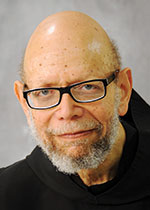 When Clarence Davis arrived in the small town of
St. Meinrad in southern Indiana in 1949 from his hometown of Washington, D.C., when he was 19, it might have seemed like he was entering a different world. The stark contrast between the two was likely heightened by the fact that Clarence was Black.
But as different as this world might have been, Clarence definitely sought it out. The son of educators, reading books on Catholicism had fascinated him, leading him to be received into the full communion of the Church when he was 15. He was also particularly drawn to monastic life and the priesthood.
That’s what led him to St. Meinrad 1949. The following year, Clarence entered the novitiate of the then-Saint Meinrad Abbey (it became an archabbey in 1954), the first Black to be received into the monastic community.
When Clarence professed temporary vows in 1951, he was given the religious name Cyprian, the name by which became well known in the decades to come around the world in the Church, in academic circles and in advocacy for Black civil rights.
Ordained a priest in 1956, Father Cyprian later earned a licentiate and doctorate in Church history at the Catholic University of Louvain in Louvain, Belgium.
When Father Cyprian returned from his graduate studies in Europe in the early 1960s, the Civil Rights Movement was growing in strength. He became involved immediately, attending the rally in his hometown of Washington on Aug. 28, 1963, in which Martin Luther King, Jr., gave his famed “I Have a Dream” speech.
Father Cyprian later took part in 1965 in the civil rights protest marches from Selma, Ala., to Montgomery, Ala.
In the Church in the U.S., he helped the country’s bishops craft two pastoral letters on racism: “Brothers and Sisters to Us,” issued in 1979, and “What We Have Seen and Heard,” issued in 1984.
During all of this activity on the national level, Father Cyprian remained dedicated for decades to helping form men for the priesthood across the country and around the world as a history professor at Saint Meinrad Seminary and School of Theology.
And while serving as a professor, Father Cyprian carried out research which resulted in the authoritative History of Black Catholics in the U.S., published in 1990.
When Father Cyprian died at the age of 84 in 2015, Father Kenneth Taylor, a Black archdiocesan priest who himself died in 2019 at the age of 67, spoke about the Benedictine priest’s role among Black Catholics in the U.S.
“He is the foundation stone for the development of black Catholic history. Covering that history that a lot of people—Black, white or anybody in the Church—were just not aware of led to the development of all kinds of other disciplines, like theology and liturgy from a black Catholic perspective.
“He had an effect all across the board in the development of the black Catholic community in the last half of the 20th century.” †
Related: Indiana’s Catholics reflect American spirit of courage and sacrifice