Peoria priest shares priestly insights of Archbishop Fulton J. Sheen
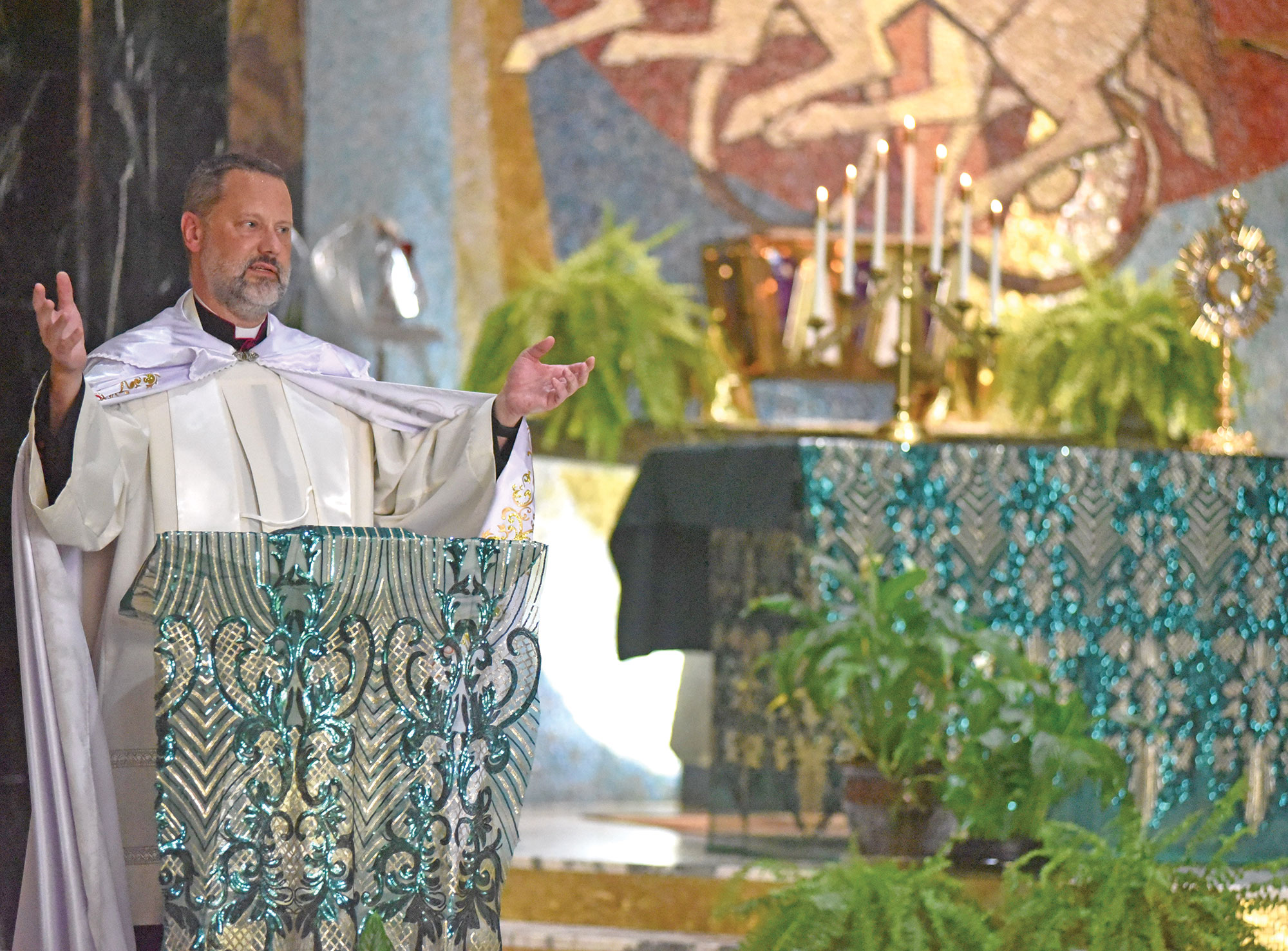
Msgr. Jason Gray, a priest of the Diocese of Peoria, Ill., gives a reflection on Aug. 9 at St. Rita Church in Indianapolis during the annual convocation of archdiocesan seminarians. The priest, who has been highly involved in the beatification and canonization cause of Archbishop Fulton J. Sheen, spoke during the convocation about the insights of the late archbishop, who died in 1979. (Photo by Sean Gallagher)
By Sean Gallagher
The annual convocation of archdiocesan seminarians that takes place in early August before they go off for a year of priestly formation at their seminaries always includes elements of a retreat for the potential future priests. (Related story: Historic number of new seminarians seen as fruit of National Eucharistic Congress)
Each day, they pray the Liturgy of the Hours together, worship at Mass, and pray in adoration of the Blessed Sacrament during a Holy Hour.
This year, Msgr. Jason Gray, a priest of the Diocese of Peoria, Ill., also offered the seminarians reflections on the priesthood from the insights of Archbishop Fulton J. Sheen, who will be declared blessed during a beatification Mass on Sept. 24 in St. Louis. Msgr. Gray serves as executive director of the Fulton J. Sheen Foundation and has been highly involved in his beatification and canonization cause.
The first of his reflections for the seminarians was given on Aug. 9 during a Holy Hour at St. Rita Church in Indianapolis where Archbishop Sheen, who died in 1979 at 84, preached on two occasions.
Msgr. Gray focused specifically on how Archbishop Sheen understood priests as victims that they themselves offer to God, a view on the priesthood rooted in Christ’s sacrifice of himself on the cross for the salvation of all humanity.
Msgr. Gray noted that many times Archbishop Sheen offered himself in this way through his grace-filled struggles with difficulties in his life.
“He said he had a fear of the cross at different stages when he was first called [to the priesthood],” Msgr. Gray said. “The idea of embracing the cross, embracing sacrifice, is something that you have to grow into. For Sheen, there was a lot of growth that occurred before he reached that point where he was really more immersed in that thinking.”
Part of a priest’s life in which he can offer himself as a victim, Msgr. Gray said, is through acts of humility and obedience, something he noted marked the early priestly life of Archbishop Sheen.
After being ordained a priest in 1919 for the Diocese of Peoria, he was sent away for graduate studies in philosophy, earning two doctorates in the field. This led him to be offered teaching positions at prestigious schools like Oxford University in Great Britain and Harvard University in Cambridge, Mass.
So, he wrote the bishop in Peoria about which invitation he should accept.
“The bishop said to come home,” Msgr. Gray said. “He assigned him to a downtown parish in Peoria where he was just a parochial vicar. And Sheen accepted that assignment.
“He threw himself into that work, dedicated himself to it, and was actually very successful in that. He preached well. He cared for the people.”
After a year in the assignment, Msgr. Gray said that the bishop allowed then-Father Sheen to take a position at The Catholic University of America in Washington, noting that in assigning him to ordinary parish ministry he had been “testing his obedience.”
Although Archbishop Sheen established his intellectual prowess at a young age and could have sat on his laurels, Msgr. Gray said he always had a great desire to learn more and renew his perspective on the subjects he taught and spoke on.
“When he finished a course, he would tear up his notes,” Msgr. Gray said.
“Then, when he would teach the course the next time, he would start fresh.”
This, he said, was another way that Archbishop Sheen offered himself as a victim since it required constant work on his part, work that he could have avoided simply by using his previous course notes.
Msgr. Gray encouraged the seminarians to take the same approach as priests when preparing to preach to their parishioners.
“A priest who is preaching should also continue to be growing in his own spiritual life,” he told the seminarians. “We should use this as an opportunity for the Scriptures to continue to challenge us, so that way we’re trying to still discover even deeper insights into individual passages, so that way our preaching becomes fresh.
“If you are a father, so a spiritual father is a priest, so don’t feed your family stale food.”
While he had many struggles in his life, Msgr. Gray said that Archbishop Sheen sought to remain joyful in the midst of them.
“Sheen was someone who was known in particular for his humor, and yet he also would talk about the fact that there was intense suffering in his experience,”
Msgr. Gray said. “Sheen was able to maintain joy while also being very much aware of personal suffering.”
This was a practice that Msgr. Gray encouraged the seminarians to make their own.
“We can be familiar with the cross and then be completely depressing and dour,” he said. “I don’t know that that’s helpful. So, maintaining a sense of joy is, I think, also something that we should also think about.” †