Trends for the Church are grim, but signs of hope exist, priest says
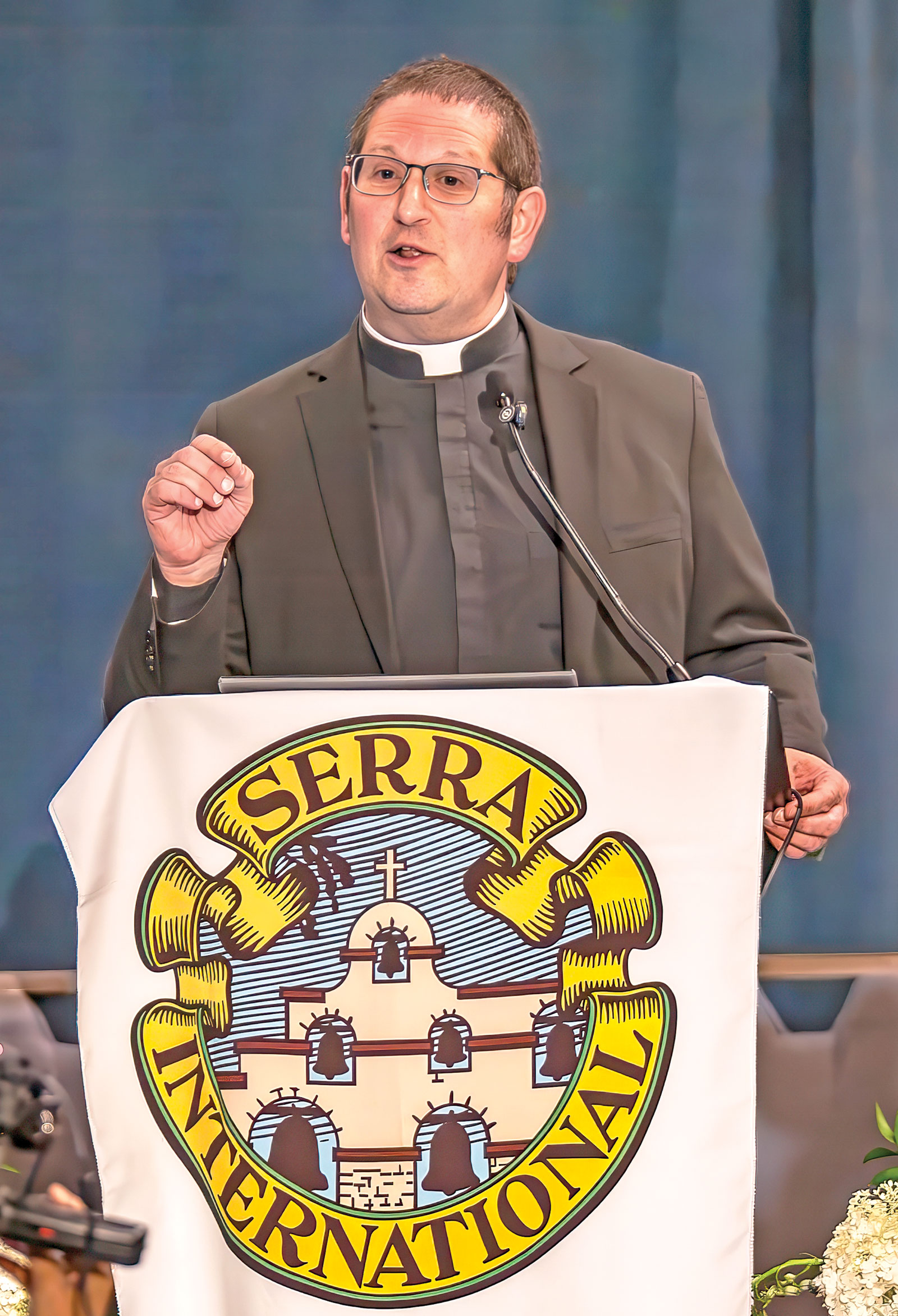
Father Eric Augenstein discusses Church trends as part of a presentation titled “Promoting Vocations in Our Current Cultural Environment” during the Serra International Convention in Indianapolis on July 11. (Submitted photo by Wayne Mikols)
By Mike Krokos
Second of two parts (Read part one here)
When he considers the research about the Catholic Church in America between 1965 and 2022, the trends are troubling to Father Eric Augenstein.
But when he considers the ways of God, Father Augenstein always has hope.
During that nearly 60-year time frame, infant baptisms went from 1.24 million annually to 438,000 annually. First Communions decreased beginning in 2010. Between 1990 and 2022, Catholic marriages were reduced by 70%.
Mass attendance has declined as well. About 30 million people attended weekly Mass in 1972. Now, it is about 18 million. At the same time, the U.S. Catholic population has increased.
“Generations have changed, the world has changed, the Church has changed,” said Father Augenstein at a July 11 presentation during the Serra International Convention in Indianapolis titled “Promoting Vocations in Our Current Cultural Environment.”
“But God is faithful and God always cares for and provides for his Church,” added Father Augenstein, who has served the majority of his 22 years of priestly life in various forms of vocations ministry in the archdiocese. He currently serves as the director of seminarians and vice rector of Bishop Simon Bruté College Seminary in Indianapolis.
The statistics cited for the Church’s sacramental practices were collected by the Center for Applied Research in the Apostolate (CARA) at Georgetown University in Washington and The Official Catholic Directory. Sociologist Ryan Burge shared these troubling trends drawn from the “General Social Survey” of the National Opinion Research Center at the University of Chicago on his blog “Graphs about Religion.” And they paint a “grim” picture, Father Augenstein said.
During the last 30-40 years, there have been some significant changes in religious affiliation and practice, noted the priest, who also serves as pastor of Holy Angels Parish and St. Rita Parish, both in Indianapolis, and as vice-president of the National Conference of Diocesan Vocations Directors.
“We’ve seen the rise of the nones,” Father Augenstein noted, those individuals who have no religious affiliation.
Burge noted that 34% of millennials (ages 31-45) have no religious affiliation. For Gen Z (high school, college and young adults ages 14-30), about 41% said they have no religious affiliation.
One survey question asked respondents: Do you know that God exists?
Forty-five percent of millennials responded “yes,” while only 35% of Gen Z did, according to the same survey as analyzed by Christian Smith, a sociologist and former University of Notre Dame professor, in his book Why Religion Went Obsolete: The Demise of Traditional Faith in America.
“You start to see the challenges that we face and the generational markers,” Father Augenstein said.
There are several reasons for the changes in the cultural landscape. Much of Father Augenstein’s presentation focused on the markers for Gen Z and what is impacting their lives. But some statistics cited millennials as well.
Father Augenstein noted that a trend of delayed commitment began with millennials. Currently, more than 50% of those ages 25-39 are not married. During the last 30 years, the average age for women to get married has increased from 24 to 29, and for men from 26 to 30.
Issues of mental health are among Gen Z’s challenges, according to author Jean Twenge in her book Generations: The Real Differences Between Gen Z, Millennials, Gen X, Boomers, and Silents—And What They Mean for America’s Future. In 2021, 30% of teenage girls suffered from clinical level depression. For teen boys, it was about 12%.
“Much of this, according to those who study such things, has been caused by digital media and smartphones,” Father Augenstein noted. Women are impacted by a culture of comparison on Instagram and TikTok, he continued.
“Life with smartphones,” he said, quoting a sociologist, “means that we are forever elsewhere.”
Members of Gen Z went through puberty in their most formative years with digital media and smartphones, he continued. “They are highly destructive in terms of self-image and to the way we interact or don’t interact with others. It’s been devastating on Gen Z.”
There are several signs of hope, the priest noted, in promoting vocations.
“There is a longing for that presence of God that the Gospel can fulfill. The Gospel offers an extraordinarily powerful response to the challenges that our culture is facing. The Gospel offers a powerful response to anxiety and depression,” Father Augenstein said. “TikTok will not give you rest. TikTok will not ease your soul. Jesus will ease your soul.”
In spite of digital media, “community and human connections are still a powerful way of living and growing closer to one another and closer to God,” the priest said.
“Particularly for Gen Z, young men and boys thrive most when they have a stable group of friends and create their strongest and most durable friendships in a group. … Discernment groups and Bible study groups are so powerful.”
Twenge’s book noted millennials want a job that is interesting and where they can make friends. Gen Z, in contrast, looks for a job in which they can make a difference in the world and serve other people.
“[That] sounds like a good entry point for priestly and religious vocations. I think we will see more of a response to priestly and religious vocations among Gen Z than we did among millennials …,” Father Augenstein said.
For many members of Gen Z, faith is something new.
“A large percentage of them grew up with no faith, and grew up in houses where parents didn’t practice a faith, and many of them were not baptized,” Father Augenstein said. “For many of them it’s not a return, it’s a new discovery, a new discovery of faith.”
When it comes to vocational discernment today in the archdiocese, family is at the core of many who are considering the priesthood or religious life, Father Augenstein noted.
“Our seminarians [in the Archdiocese of Indianapolis] most often come from an active family of faith, both parents are Catholic, and in an intact marriage,” he said. “They also are more often coming from large families.”
As noted in Smith’s book, Gen Z values having experiences more than possessing things, another trend the Church can “build on,” Father Augenstein said. They also thrive in peer relationships and being a part of a community.
“The Mass is … an encounter with God and the Church. So, we can’t settle for a mediocre version of the faith, for an individualized version of the faith. We have to offer opportunities for our young people to experience God.”
This is why eucharistic adoration is becoming powerful among Gen Z, he continued. “It’s an experience, an encounter, a personal encounter with God in the midst of the Church.” †
Related story: ‘Vocational seeds’ are sown at National Eucharistic Congress, priest notes