Bishop Martin Marty inspired a saint as a missionary to Native Americans
By Sean Gallagher
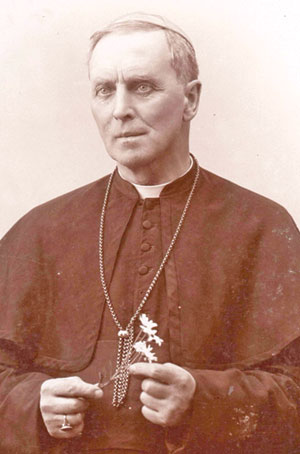 Born in 1834, Bishop Martin Marty came to Indiana in 1860 as a Benedictine monk of Einsiedeln Abbey in Switzerland. The abbot of Einsiedeln sent him to the fledgling Saint Meinrad Priory in southern Indiana, founded six years earlier by the Swiss monastery.
Facing various problems, Saint Meinrad was in danger of being closed. Father Martin was able to stabilize its community life and served as its first abbot when it became an independent abbey.
In coming to America, Father Martin also had an interest in serving as a missionary to Native Americans. In his earlier education, he had been inspired by the stories of Jesuit Father Pierre-Jean De Smet, who ministered among the Native Americans in the Northern Plains, the Rocky Mountains and the Pacific Northwest from 1838-68.
This desire began to be fulfilled in 1876 when Abbot Martin traveled to the Standing Rock Reservation, which today straddles North Dakota and South Dakota, to investigate if it might be possible to found a monastery there. He arrived around the same time that Lakota chief Sitting Bull led a group of Native American warriors to victory over American Army forces led by General George Custer in the historic Battle of the Little Bighorn in what is now southeastern Montana.
While Saint Meinrad did not establish a monastery in the Dakotas at that time, Abbot Martin, showing capability and determination for the challenging life of a missionary among the Sioux, was appointed a bishop for the Dakota Territory in 1879. He was later appointed bishop of Sioux Falls, S.D., in 1889; and bishop of Saint Cloud, Minn., in 1895, dying a year later at the age of 62.
The gaunt 5-foot-10-inch bishop, who weighed 130 pounds and was known among the Sioux as “Black Robe Lean Chief,” met with Sitting Bull twice in his ministry in the Dakotas.
In addition to building upon the Church’s missionary work among the Native Americans of the northern Plains previously done by Father de Smet, Bishop Marty also contributed to the growth in holiness of an American saint.
In a letter written in 1922, St. Katherine Drexel wrote about how she, at the time a young adult woman from a wealthy Philadelphia family, met Bishop Marty on various occasions and was impressed by his zeal for missionary work among the Native Americans.
St. Katherine went on in 1886 to found a community of women religious dedicated to ministering among Blacks and Native Americans. In her 1922 letter, she wrote that Bishop Marty helped her realize her “missionary vocation,” adding that “had I not met Bishop Marty, my whole future career might have been entirely different.” She was declared a saint in 2000 by St. John Paul II.
Bishop Martin’s life is recounted in some detail in Benedictine Father Albert Kleber’s History of St. Meinrad Archabbey, 1854-1954, written for the monastery’s centennial. †
Related: Indiana’s Catholics reflect American spirit of courage and sacrifice