‘True servant leader’ retires as St. Elizabeth Catholic Charities agency director
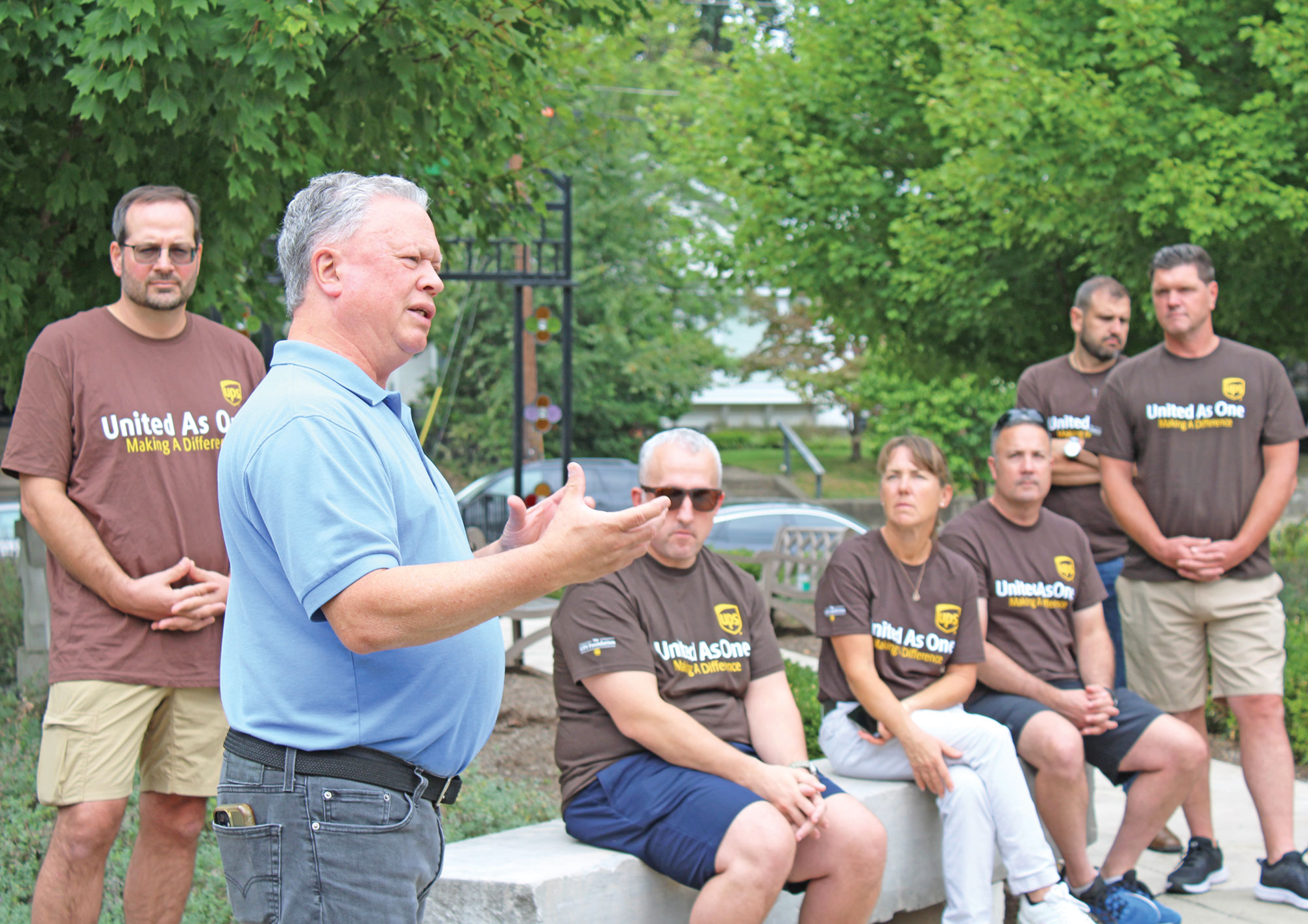
St. Elizabeth Catholic Charities agency director Mark Casper addresses volunteers in Holy Trinity Heritage Park next to the agency’s administration building in New Albany on Sept. 10, 2025. Casper is set to retire at the end of July after 18 years of leading the agency. (Photo courtesy of St. Elizabeth Catholic Charities staff)
By Natalie Hoefer
NEW ALBANY—When Mark Casper was hired as
agency director of St. Elizabeth Catholic Charities (SECC) in New Albany in 2008, he had no “grand plan.”
“I never planned, ‘Let’s buy up a block, or let’s take on domestic violence, or let’s start an affordable supportive housing program,” says Casper.
But under his leadership, the social services agency accomplished those expansions—and so much more.
“He was the right person at the right time,” says former SECC advisory council president Phil McCauley, who brought Casper onto the council in 2006.
Phil Kruer, another former council president, says Casper took SECC “from probably one of the best secrets in New Albany to now one of the most well-known and
well-respected social services agencies in New Albany.”
Even higher praise comes from David Bethuram.
“Mark is a true servant leader—mission driven, empathetic and adaptable,” says the executive director of the archdiocesan Secretariat for Catholic Charities. “Throughout his tenure, he has built trust and fostered strong collaboration among staff and stakeholders, always ensuring that the clients served by St. Elizabeth Catholic Charities remain at the heart of every decision the agency makes.”
Those decisions will soon fall to someone else as Casper, 65, prepares to retire at the end of July.
“I can’t believe it’s been 18 years,” he says. “It flew by. There was never a day where I hated going to work—it was never a job.”
The foundation for Casper’s role was laid early in his upbringing.
‘It was a perfect fit’
Casper was raised the eighth of nine children in “a very Catholic family” in Louisville, Ky.
For his big family, “economics was a challenge, so I understand people being vulnerable and in need,” he says.
In high school, Casper already showed promise as a leader with a knack for business. During his junior and senior years, he was president of his Catholic school’s Junior Achievement (JA) company, a program that guides students as they design, fund and manage a business venture. The secretary the same two years was a young woman named Cindy—the future Mrs. Casper.
After college, he worked at a manufacturing plant, eventually becoming head of manufacturing.
The family moved in 1998 to Jeffersonville, where they became members of Most Sacred Heart of Jesus Parish. That’s where Casper met fellow parishioner McCauley, who invited him to a few SECC annual galas and eventually onto the agency’s advisory council in 2006.
“I saw the quality of person he was, and I thought he’d be good on our finance committee,” McCauley recalls.
After 25 years in manufacturing, Casper left his fast-paced, high-pressure management job early in 2008, saying he “ready for a career change … for something that was much more intrinsically rewarding.”
That opportunity arrived in the spring when Casper’s family vacation to Disney World was interrupted by two calls. In the first, he was informed that the SECC director was no longer with the agency. The second call was from David Siler, then-executive director of the archdiocesan Secretariat for Catholic Charities, saying he heard Casper was “interested in a career change.”
When the two met in person the following week, he told Siler he’d try the role for six months then re-evaluate.
He started on April 7, and “we never even had a discussion at six months,” says Casper. “It was a perfect fit.”
He wasted no time making a positive impact on the agency.
‘Looking at gaps and community needs’
Casper’s first goal was improving SECC’s finances, “refocusing them on earned income and grants and away from dependence on program-based income.”
His efforts paid off—literally. In his 18 years, the agency’s budget grew from $500,000 to $2 million, with one year’s worth of operating expenses in reserve.
The strategy was a benefit to the agency, its staff and especially those they served.
“When COVID hit and nobody could work, we just literally said, ‘Nobody pay rent. Everybody just survive,’ ” Casper says of those living in the agency’s Affordable Supportive Housing (ASH) units. “We couldn’t do that if our rent wasn’t, like, half of 1% of our $2 million budget or if we depended on program-based income. … We take a lot of pride in that 92.4 cents of every dollar goes to direct services, and not a lot of nonprofits can say that.”
The budget’s growth enabled growth of another kind. Under Casper’s leadership, the agency expanded gradually from two buildings in 2008 to today’s campus of an entire neighborhood block with eight buildings and Holy Trinity Heritage Park, plus four adjacent properties for future expansion.
The purpose was not growth for growth’s sake. The purchases were “based on a strategic planning process that required looking at gaps and community needs,” says Casper. “Those needs and gaps change, and we adapted to meet them.”
In time, the properties purchased based on the plan allowed for a larger maternity home plus three new housing programs: nine ASH units with a sliding pay scale, a women and children emergency shelter and transitional housing for domestic violence victims.
“We call it a continuum of care,” says Kruer. He served on the advisory council for 16 of Casper’s 18-year tenure, including 10 years as head of the facilities committee during the majority of the agency’s growth.
“Before [the expansion of programs], we would be in [the women’s] lives for just a small portion, and they would have to move on to other agencies. With Mark’s vision and guidance, we can be there for them as their needs evolve.”
Some community needs went beyond housing, and Casper led the agency’s response there as well.
‘You have to be there to be there’
In 2014, he expanded the agency’s adoption services by merging with Louisville-based Adoption Bridges of Kentucky (now “of Kentuckiana”), and in 2015 the agency began offering counseling services for Catholic schools in the New Albany Deanery.
“The one thing I’ve learned is you have to be there to be there,” Casper says. “Had we not seen the need for school counselors [in the deanery’s Catholic schools] earlier, we wouldn’t have been there when COVID exploded that need.”
Such forward thinking shows how Casper “has guided the agency with both vision and humility,” says Bethuram. “Under his direction, the agency’s programs have grown not only in scale but in depth—strengthening support systems, increasing access to essential resources, and ensuring that those most in need receive compassionate, life changing care.”
The programs and care are certified top-notch. In 2012, Casper led the agency in applying for and obtaining SECC’s accreditation as a social services agency from the Council of Accreditation. That status has been renewed every four years since.
“I always say [SECC] is good people doing good things,” says Casper. “But to have a very tough outside agency coming in, documenting, testing, and at the end passing us as meeting all the needs of a world class social service agency—that is one of the things I’m most proud of” in his 18 years as agency director.
It’s a tremendous, behind-the-scenes legacy of Casper’s tenure—but there are visible legacies, too.
‘We wanted to be good stewards’
In 2012, St. Mary Parish in New Albany transferred to SECC ownership of two properties across the street from the agency’s campus. They included the rectory of the former Holy Trinity Parish and the land next to it where the church once stood before a fire destroyed it in 1975, leaving nothing but a few wall remnants.
The rectory, built in 1850, became SECC’s new administration building—but not before a complete restoration.
“We wanted to be good stewards of the property, but also of our finances,” says Casper. So, he, council members, staff and volunteers did as much of the restoration work as possible.
“Mark put so much energy into restoring that building,” recalls former advisory council member Fran Brown. “He was in there on his hands and knees scraping gunk off of the hardwood floors and painting. If he does anything, he does it 100%.”
Casper’s vision for the vacant lot where the church stood further proves her point.
Through separate fundraising efforts, he launched a project to transform the “eyesore” property into a community green space called Holy Trinity Heritage Park—even restoring and incorporating some of the church’s stained-glass windows from 1890 that survived the fire.
“He didn’t need to do all that,” former advisory council member Ken Johnson says of the project. “It shows the importance he places on giving back to the community and respecting our Catholic heritage.”
Casper continued being a “good steward” of finances and the property as the park project progressed—with Cindy by his side.
Late one June early in the project, 652 plants and bushes were planted and had to be watered for three months.
“So, every Saturday and Sunday the rest of June and then July and August, Cindy would come with me, and she’d take one end of the park, I’d take the other, and we’d water all those plants.
“I can’t tell you the number of times Cindy, my daughters and, after they married, my son-in-laws helped at events, moved furniture, set up tents and chairs, went to the gala,” Casper reflects.
“They’ve all been hands-on involved and very, very supportive. Particularly Cindy—it’s not ‘you’ or ‘me’ but ‘we.’ ”
Others have been supportive, too.
‘So near and dear to his heart’
“The job is too big for one person—it takes a village,” says Casper.
He attributes SECC’s success to its “amazing council members, dedicated and passionate staff and the most generous, caring community. We absolutely couldn’t have done all we did the last 18 years without everyone’s help.”
Among those accomplishments, Casper names three he is most proud of.
“First is seeing the growth of the agency, to become what we become, what the community needed us to become,” he says. Second was obtaining accreditation, and third was securing SECC’s financial stability.
“In my 18 years, we never shut a program down or reduced staff because of lack of funds,” says Casper. “You know, you do the right thing, and the numbers will take care of themselves.”
There was also divine help, Casper adds, saying he “could write a book on how many God moments there have been.”
And then there are the moments that define his passion for the agency’s cause.
“The one time that I see Mark get emotional is at the gala when he speaks about our clients,” says Kruer. “They are so near and dear to his heart.”
Casper still gets emotional when recalling the story told at one gala by a Court Appointed Special Advocate (CASA) volunteer when SECC hosted the program.
“When the CASA volunteer told [a foster child] about moving to a new home—and it still gets me,” says Casper, pausing to hold back tears—“the little boy asked her, ‘Will there be food at the next house?’ In America, no kid should ever ask that question.”
He calls himself “a big believer in breaking the cycle of poverty.”
So, it makes sense that what he loved most in his job was “seeing all the baby steps of success” the women made, like those who “were able to stay off drugs, or got out of an unhealthy relationship, or learned to manage money or got custody of her child back.”
One thing Casper says he won’t miss, though, is time spent away from his family—time he hopes to make up in retirement.
There isn’t “a huge list of plans” for his next chapter, Casper says. He and Cindy will do “a little travel,” but mostly will “enjoy the sun” at their pool and on their boat, and spend time with their daughters, sons-in law and Casper’s retired siblings.
But highest on his list is being “Poppy” to his 3-year-old grandson.
“After having twin daughters, we finally got a boy in our life who likes boy stuff, and right now he thinks Poppy can hang the moon,” Casper says with a joyful smile. “So, I look forward to soaking up that admiration for a while.”
Whatever he does, Casper should retire “a very fulfilled person, because he’s brought along so much good,” says McCauley. “We just need more Marks in this world.”
Johnson agrees.
“We stand on the shoulders of those that came before us,” he says. “He’ll be a tough act to follow.”
(For more information on the St. Elizabeth Catholic Charities agency director position or to apply, go to stecharities.org/career-opportunities.) †