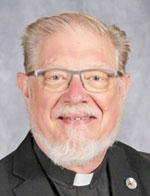
That All May Be One / Fr. Rick Ginther
Scripture study between Catholics and Jews paves way for understanding
 What might happen if Catholic priests and lay leaders gathered with Jewish rabbis and lay leaders to explore our shared sacred texts?
What could we learn from one another?
That the sacred texts which Christians call the Old Testament, Jews call the Tenakh.
That the Christian books number 39 (Catholic edition, 46) and the Tenakh books 24.
That the Christian books are divided into sections: Pentateuch, Historical, Novellas, Wisdom, and Prophetic.
That the Jewish canon has three sections: the Torah (Law), Nevi’im (Prophets), and Ketuvim (Writings).
Some of the books in the Jewish canon are combined; thus, the smaller number.
Beyond such facts, there is so much more.
The Indianapolis Jewish Community Relations Council (JCRC) and the Archdiocese of Indianapolis partnered to create such a gathering of Jews and Catholics called “Voices Ancient and Modern.” It was held at St. Luke the Evangelist Parish in Indianapolis on June 9.
Present were four rabbis, 10 Jewish lay leaders, four priests, four theology and/or Scripture professors, six Catholic lay leaders and one Messianic Jew.
The inspiration for this gathering came from the spirit of the Second Vatican Council document “Nostra Aetate,” which helped transform Catholic-Jewish relations.
In November 2025, JCRC and the archdiocese put on a program and panel discussion commemorating the 60th anniversary of the “Nostra Aetate” declaration. It was at that event that panel member Rabbi Dennis Sasso, Senior Rabbi Emeritus of Congregation Beth-El Zedeck in Indianapolis, suggested a series of text study gatherings.
The goal for the first gathering was twofold: to understand how each tradition interprets sacred texts, and
to build relationships through serious
and respectful conversation.
During the session, I set out a basic Catholic framing for our gathering. Rabbi Sasso followed with a Jewish framing.
A video was shown featuring Catholic and Jewish scholars who spoke of the similarities and differences in how each faith tradition approaches the sacred texts.
Those gathered then explored three texts: the story of Jacob and Esau (Gen 25:22-23), Psalm 23 and Isaiah 49:3-6.
For each, there were questions: How does each faith use the texts in prayer or worship? How does each understand the texts today? What about the text strengthens the Jewish or Catholic reader’s faith?
Regarding Jacob and Esau, a common pattern of storytelling emerged in our shared sacred texts: a younger or the youngest son often being the favored one (Isaac, David, Joseph, etc.).
For Psalm 23, we discussed where we most often encounter it in our individual traditions. We also shared which image of God emerges most powerfully: shepherd, protector, guide, comforter.
The final text was Isaiah 49:3-6. This beginning of the second Suffering Servant song is variously interpreted among both Catholic and Jewish scholars.
The participants were asked to share who or what they understood the servant to be. Their varied responses allowed Catholics and Jews present to discuss the text honestly, allowing for the real differences and similarities to emerge as a dialogue of understanding.
As we parted, we applauded the opportunity and acknowledged we had met new friends both Catholic and Jewish.
We knew that we had embarked on an ongoing opportunity for Catholics and Jews to study together and build long-lasting relationships.
(Father Rick Ginther is director of the archdiocesan Office of Ecumenism and Interreligious Affairs. He is retired from full-time pastoral ministry, but is still active as a priest of the archdiocese.) †