Sculptor captures essence of America’s first recognized priest of African descent
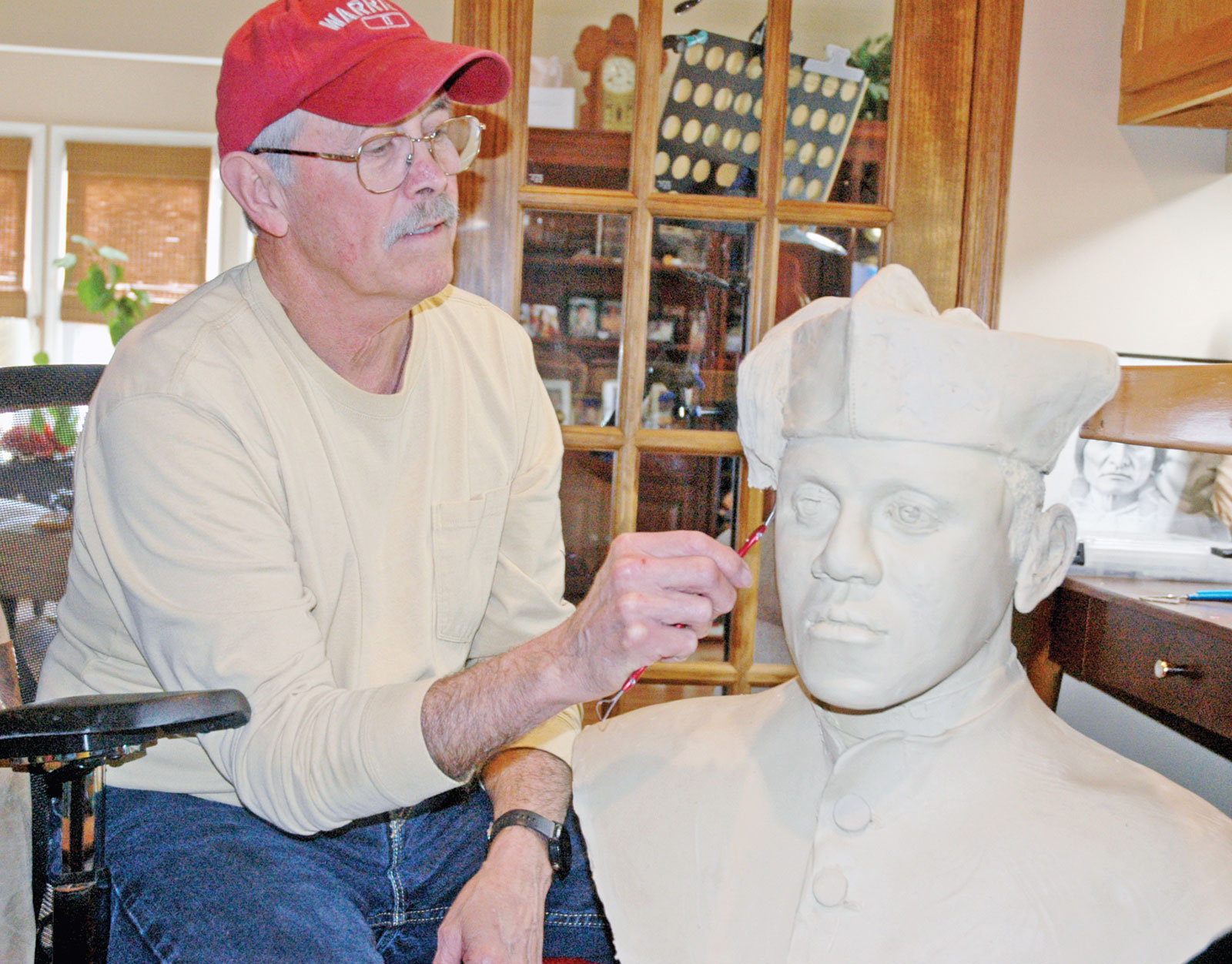
Forrest Tucker uses a sculpting knife to trim a clay bust of Venerable Augustus Tolton, the first recognized priest of African descent in the United States. (Photo by John Shaughnessy)
(Editor’s note: This story is a shortened version of the original one that appeared in The Criterion on April 12, 2024.)
By John Shaughnessy
This is the unlikely story of the connection between Forrest Tucker, a humble sculptor from the countryside of Hendricks County, and Father Augustus Tolton, who was born into slavery and overcame the racism of his country and his Church to become a boundless source of hope, humanity and Christ’s love in the slums of Chicago in the late 19th century.
Even a short summary of Father Tolton’s life would leave most people in awe—which is the impact it had on Tucker.
“He was born a slave in 1854. His mother was on a plantation where the plantation owners were Catholic. That was an aspect that caught me off guard—Catholic slave owners,” Tucker said, shaking his head in dismay.
“They educated their slaves and catechized their slaves. They went to Mass. Father Tolton learned how to read Scripture. His mother was a very faithful and devout Catholic, and she had an influence on him to not lose his faith, his love of God.”
Tucker is also touched by the bravery of Father Tolton’s mother, the bravery she showed in gaining freedom for herself and her three children. Escaping from the slave owners during the Civil War, she led her children across the Mississippi River and into Quincy, Ill., with the help of Union soldiers in 1862.
“The first place they went was to a Catholic church,” marveled Tucker, a member of Mary, Queen of Peace Parish in Danville. “And the church helped them.”
Embracing the faith that his mother loved, he sought to serve God and the Catholic Church as a priest. Yet no seminary in the United States at the time would accept a Black man. Still, through the influence of his pastor, Father Peter McGirr, and other priests in Quincy, a seminary in Rome invited him to pursue studies for the priesthood, leading Father Tolton to be ordained on April 24, 1886.
Assigned to return to Quincy, the 31-year-old Father Tolton became the first recognized priest of African descent in the United States. He ministered to both Blacks and whites, seeking to draw them closer to God and each other, even in the face of continued racism. Later transferring to Chicago, he served in the city’s slums, caring for the spiritual and physical needs of the poor and the sick until his death due to heat stroke in 1897 at the age of 43.
The details of Father Tolton’s life have touched Tucker to his core.
“Perseverance comes to mind about him,” Tucker says. “Despite what he went through, the obstacles that were in his way, he never wavered in his faith. He let nothing separate him from God. That was one of the big takeaways for me.”
While Father Tolton’s life was marked by an undeniable perseverance, the image of him extending his hand in compassion to a grieving woman persisted in the mind of Tucker.
“At first, it didn’t even come to my mind that this was a sculpture,” Tucker says. “But I kept thinking about it.”
He prayed to the Holy Spirit for guidance and began sculpting the image in 2022. He finished it in 2024, 14 years after the sainthood cause for Father Tolton began. In 2019, Pope Francis declared the priest venerable, a sign that the Church recognizes that he lived a life of heroic virtue.
The next step in Father Tolton’s sainthood cause would be for him to be declared blessed. That usually happens when the Church recognizes that his intercession has led to a miraculous healing. Another such intercession would result in him being declared a saint.
As for Tucker, he hopes he has captured Father Tolton’s spirit in his sculpture of the priest and the grieving woman.
“She’s finally turning toward God,” Tucker says. “She doesn’t have any strength in her body but to lift her hand. Tolton’s hand, his palm is up. She has to put her hand in his. She turns and looks at God through the eyes of Tolton.”
The power of that image is matched by the power in the words that Tucker uses to capture the essence of Father Tolton’s life, the essence of life that all people share.
“Life can be pretty tough, and you can encounter some pretty tough obstacles,” Tucker says. “Yet no matter what happens to you, there’s nothing that can separate you from God.” †
Related: Indiana’s Catholics reflect American spirit of courage and sacrifice