Amid technological change, Archbishop Thompson says encyclical gives people hope for the future
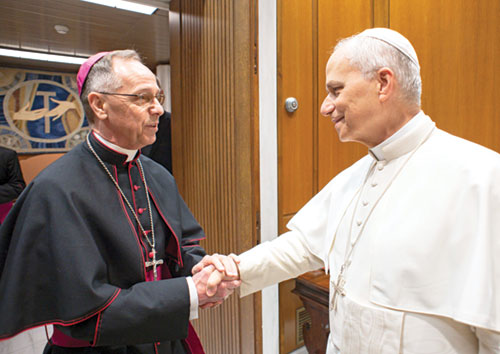
Archbishop Charles C. Thompson greets Pope Leo XIV on Sept. 27, 2025, during a private audience at the Vatican. At the time, the archbishop was leading a pilgrimage for the Jubilee of Catechists. (CNS Photo/Vatican Media)
By Sean Gallagher
Upon reading Pope Leo XIV’s first encyclical letter, “Magnifica Humanitas: On Safeguarding the Human Person
in the Time of Artificial Intelligence,” Archbishop Charles
C. Thompson appreciated the pontiff’s ability to “say some
very profound things in some very down-to-earth ways.”
The archbishop reflected on Pope Leo’s encyclical, which was issued on May 25, in a recent interview with The Criterion.
While much attention has been given to the document’s focus on artificial intelligence (AI), its subtitle reveals another topic just as central in Pope Leo’s mind: the human person.
He explores at length in the encyclical what it means to be human, how the Catholic faith is both rooted in humanity and strengthens it through its social doctrine and the threats humanity faces in emerging technology today.
Archbishop Thompson also focused on the human person in the first pastoral letter he issued after he was appointed on June 13, 2017, to lead the Church in central and southern Indiana.
In “We are One in Christ: A Pastoral Letter on Fundamentals of Christian Anthropology,” Archbishop Thompson offered perspectives from the Church’s understanding of the human person on issues facing society then, including offenses against the sanctity of human life, racism and difficulties faced by migrants and refugees.
St. John Paul II’s first encyclical letter “Redemptor Hominis,” issued in 1979, also focused on Christian anthropology.
Why has this particular fundamental teaching been given so much attention in the Church at both the local and universal levels in recent decades?
“It goes back to how John XXIII saw the Second Vatican Council,” said Archbishop Thompson. “Even then, he saw how quickly technology and the sciences were advancing in the late ‘50s and early ‘60s. He felt like the Church had to have a voice in that conversation, and that voice being [focused] on Christian anthropology.”
That aspect of the Church’s teaching remains critically important today, Archbishop Thompson noted, adding that the power of its understanding of the human person to positively shape society is rooted in its ties to Christ and the Holy Spirit.
“The Church has a certain perspective and a voice, and it brings a certain depth of witness and history, all effective for us in being animated by the Holy Spirit, of course, and centered in Christ,” he said. “It brings that perspective to that conversation—especially the Christian anthropological understanding.”
The Church’s understanding of the nature of the human person is expressed most completely in its modern social doctrine, which first began to be articulated by Pope Leo XIII in his 1891 encyclical letter “Rerum Novarum,” in which he applied the Church’s teachings on the human person and society to the effects of the Industrial Revolution.
Among the principles in Catholic social doctrine, which Pope Leo XIV explores at length in his encyclical, the Church proclaims that every human person has an inherent dignity by being created in God’s image and likeness. It promotes solidarity among all people, as well as subsidiarity, the principle that decisions about society should be decided at the lowest level possible. And it places a high value on the common good and a preference on serving the poor.
Archbishop Thompson spoke of his appreciation of Pope Leo’s explanation of Catholic social doctrine in the encyclical and how it has developed since the late 19th century.
“I liked how he talks about Catholic social teaching as born of both Scripture, Church tradition, as well as reading the signs of the times in relationship with the sciences and the other aspects of the world,” Archbishop Thompson said. “They’ve developed from that experience.”
He also knows that being focused on the “signs of the times” can understandably lead some people to see the period in which they’re living as “a unique time of adversity.”
What Pope Leo offers in his encyclical, though, can help believers get a broader perspective on what’s happening here and now, Archbishop Thompson noted.
“As Pope Leo tries to lay out in this document, there’s nothing insurmountable in our time more than in others,” he said. “Yes, we have our challenges with what technology can do right now with war, violence, weapons, the manipulation of the truth and how it’s all advancing so quickly.”
But despite these troubling trends, Archbishop Thompson remained confident about the direction in which the Church can lead the faithful and others who are open to its teachings on the human person and society.
“We still have to be grounded in the same principles of the dignity of the person, the sanctity of life, the defense of family, our option for the poor and the vulnerable—all those things,” he said. “We maintain all those.”
While Catholic social teaching, as explained in “Magnifica Humanitas” and applied to questions related to emerging technology, can help believers be confident in uncertain times, Archbishop Thompson said Pope Leo took the long view in his encyclical about the task of guiding AI and other emerging technology according to moral norms that respect human dignity.
“He’s very realistic,” the archbishop said. “He says there’s no quick fix to this, and there’s no one way that is going to fix this. There are going to be a number of different ways that we go about this.”
While that may be the case for society on broad questions like the effects of AI on education, labor and families, as shepherd for the Church in central and southern Indiana, Archbishop Thompson is focused on coming to a greater understanding of what the pope is teaching and passing that on to the faithful.
“That’s what a bishop has to do,” he said. “He takes his lead from the Holy Father. I think priests should be taking their lead from the Holy Father and the bishop, and in not only what he says, but also in what he does.”
And for Archbishop Thompson, an important part of Pope Leo’s example for all the faithful in this “time of artificial intelligence”—when changes seem to be happening so quickly and it’s hard to know what AI’s effects will be even months from now—is the pontiff’s confidence in Christ’s guidance and protection.
“Don’t get lost,” Archbishop Thompson said. “Don’t get overwhelmed by the times. Reading the signs of the times shouldn’t overwhelm us, but should help us to find Christ at the center of all of that.”
(To read Pope Leo XIV’s encyclical letter “Magnifica Humanitas,” visit cutt.ly/MHencyclical. Read the June 26 issue of The Criterion for another local article on the pope’s new encyclical.) †