Corrections Ministry is ‘a core Christian practice,’ says new coordinator
By Natalie Hoefer
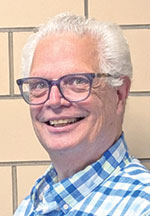 Those seeking counseling, hospital patients and those incarcerated—on the surface, the three categories of people might seem very different.
But Deacon Richard (Rick) Renzi sees a common thread among them.
People in each of those situations “tend to ask very similar questions, like, ‘Is this all there is to life? What is the meaning and purpose of my life? Does God love me? Is God angry with me? Does God even exist?’ ” says the mental health therapist-turned hospital chaplain-turned new archdiocesan coordinator of Corrections Ministry.
“When I interviewed for the position, I felt truly called to this ministry,” adds Deacon Renzi. “I see it as a sacred work that approaches these questions and attempts to give [those in correctional facilities] meaning and purpose.”
The ministry falls under the umbrella of the archdiocese’s Secretariat for Catholic Charities.
“I’m very excited to work with Deacon Rick,” says David Bethuram, executive director of the secretariat. “He brings to the archdiocesan Corrections Ministry a remarkable blend of pastoral sensitivity, administrative skill and spiritual leadership.”
Those qualities developed throughout Deacon Renzi’s career, starting with his first job as a therapist.
‘It’s more important to be a loving presence’
He did this work at BryLin Hospital, a crisis mental health care facility in Buffalo, N.Y., serving youths and adults in the hospital’s addictions program.
Deacon Renzi had his first experience with corrections ministry there.
“BryLin was close to Attica [Correctional Facility], so we took troubled youths that already were having problems with crime, and a select group of prisoners talked to them to try and help them,” he explains. “I learned a lot through that experience.”
After his 10-year career as a therapist, Deacon Renzi ministered as a hospital chaplain for 26 years. He retired in January from his role as manager of spiritual care for the central region of the Ascension St. Vincent hospital network.
Then Deacon Renzi learned about the opening for Corrections Ministry coordinator.
The position involves several aspects: overseeing the sacramental needs of Catholics incarcerated within the archdiocese’s boundaries; supplying clothing, job-site tools and other small items through the ministry’s Re-entry Gift Program to help those re-entering society; ministering to those who have experienced or been affected by incarceration; and encouraging parish involvement.
But it’s the ministerial aspect of the position that drew Deacon Renzi, blending his skills and experience as a therapist and hospital chaplain.
“As a therapist, I learned that it’s more important to be a loving presence than try to fix things or take away the pain they might be going through,” he says.
And as a hospital chaplain, Deacon Renzi realized that “hospitals are full of people who are not just physically ill but also broken and suffering. … I truly believe the same is true of those affected by incarceration.”
Both experiences helped him develop “a listening posture and presence to hear someone’s pain and suffering,” says Deacon Renzi. “It’s about being an attentive listener and reflecting back what you heard with no judgment … and radiating God’s love to the person.”
Corrections ministry involves the same approach, he says. It’s an opportunity “to make ourselves available to those who are incarcerated or affected by incarceration, to journey with them in their time of crisis, fear, anger, anxiety, doubt—whatever thoughts and feelings might arise—and try to support them and stand with them as a person of faith and hope.”
The more Deacon Renzi discerned, the more he felt called to the position. With barely a heartbeat passing since he retired, he applied for the role.
The match was clear to Bethuram.
“Corrections ministry requires deep compassion, firm boundaries, strong organizational ability and a heart firmly rooted in Catholic teaching,” he says.
“With his many years of experience as a Catholic hospital chaplain, a mental health therapist and a permanent deacon for the archdiocese, [Deacon Renzi] offers exactly the kind of leadership this role demands.”
He started in his new position in May and already has a vision for the ministry.
‘A core Christian practice’
Part of that vision is based on an observation through his interactions in corrections ministry that “there seems to be a variety of ways people go about helping. There doesn’t seem to be a uniform or structured approach. With my background as a former chaplain and therapist, I feel this could possibly lead to more harm than good.”
Deacon Renzi believes “a more formal approach to training clergy and others to go into prisons and detention centers” would overcome the problem.
Another part of his vision involves “a paradigm shift,” he says.
“I would like to move corrections ministry from a peripheral charitable act to a central expression of Christian discipleship within the archdiocese and parish life,” Deacon Renzi says.
His inspiration for this shift comes from Scripture, particularly two passages in the Gospel of Matthew that “resonate” with him: “I was in prison and you visited me” (Mt 25:36) and, “Truly I tell you, whatever you did for one of these least of my brothers, you did for me” (Mt 25:40).
The passages shape his vision of “expanded participation in corrections ministry as a core Christian practice, with more diverse groups … visiting those who are incarcerated to build community and spiritual growth.”
Deacon Renzi’s hope for these changes comes amid his own time of change.
It began with his retirement in January, followed by applying and being hired for the coordinator of the Corrections Ministry role. But “divine providence” had one more change in store for him.
Earlier in the year, Deacon David Bartolowitz, archdiocesan director of the Office of Deacons, asked Deacon Renzi if he would be open to a new parish assignment.
“I had been serving as permanent deacon at St. Malachy [Parish in Brownsburg] for 14 years,” he says. “But I told him when I answered a call to the diaconate ministry, I didn’t put limits on what God and the Church asked of me, so I said I’d be willing to go somewhere else.”
Deacon Renzi didn’t know how quickly he would have to follow through on that promise. What “felt like only a month later,” he was reassigned to
St. Monica Parish in Indianapolis.
Retirement, a new assignment and a new job withing five months?
“It’s been a little bit too much change for me,” Deacon Renzi admits with a laugh. “But I’m adapting and coping as best I can—it’s all divine providence.”
Despite the whirlwind, he is excited about the opportunity through his new coordinator role to make a positive impact on people’s lives.
“I’m keenly aware that people remember positive and negative experiences,” Deacon Renzi says. “I think it’s imperative in this ministry that we remember that we’re engaging in experiences, and how we show up helps people to experience being cared for and feeling heard, being seen and not feeling forgotten, because we took the time to listen.”
(For more information on the archdiocese’s Corrections Ministry, its resources, how to volunteer or to donate to its Re-entry program, go to archindy.org/corrections-ministry or contact Deacon Richard Renzi at
rrenzi@archindy.org or 317-669-8761.) †